


Norden Leacox Accident & Injury Law | August 27, 2026 | Personal Injury
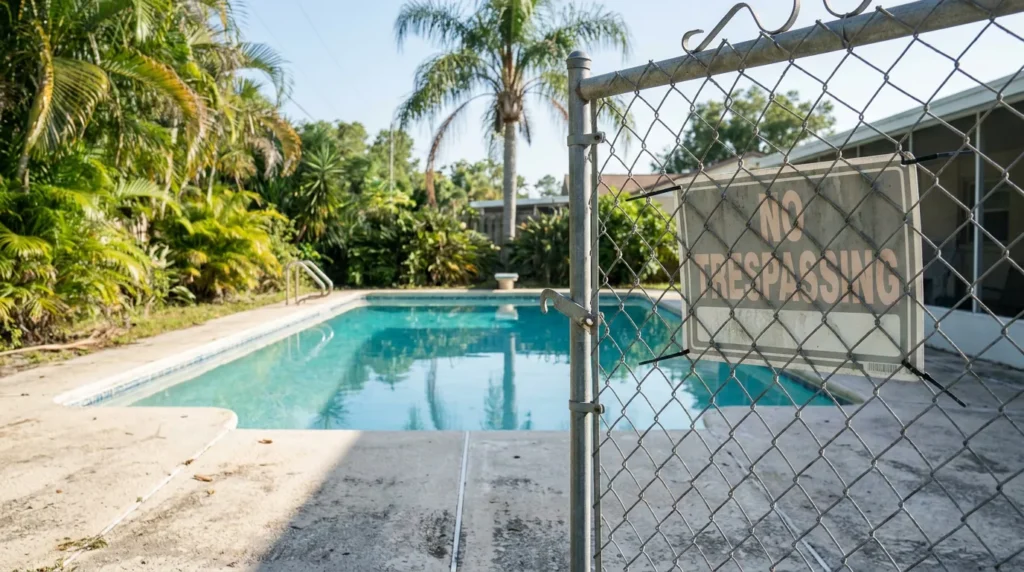
Why Florida Law Treats Backyard Pools Differently Than Other Hazards
Key Takeaways: The attractive nuisance doctrine may hold an Orlando property owner liable when a young child is drawn onto the property by a hazard like a swimming pool and is injured or drowns, even if the child trespassed. Florida’s trespasser statute, Fla. Stat. § 768.075(3)(b), generally imposes minimal duty, but § 768.075(3)(c) preserves the common law attractive nuisance doctrine as an exception. Application depends on the child’s age, pool accessibility, and owner precautions. Noncompliance with Chapter 515 barrier requirements can evidence negligence. Claims require proof of duty, breach, causation, and damages, supported by photographs, records, and witness statements. For causes of action accruing on or after March 24, 2023, most negligence and wrongful death claims must be filed within two years under Fla. Stat. § 95.11(5).
The attractive nuisance doctrine is a common law principle that may hold a property owner responsible when a young child is drawn onto the property by something dangerous and enticing, such as a swimming pool, and is injured or drowns. Florida sharply limits what a landowner owes a trespasser, but children are treated differently because the law recognizes that a young child often cannot appreciate the risk an open, unfenced pool presents. For Orlando families, this doctrine can be the difference between having a viable claim and having none.
If your child was hurt or lost in a pool incident on someone else’s property, the team at Norden Leacox can review what happened and explain your options. Call 407-801-3000 or contact us now to speak with our team about a confidential case review.

How the Attractive Nuisance Doctrine Florida Pools Rule Fits Into State Law
Florida’s trespasser statute sets a low baseline duty, and the attractive nuisance doctrine carves out an exception. Under Fla. Stat. § 768.075(3)(b), a property owner generally must only refrain from intentional misconduct toward an undiscovered trespasser and owes no duty to warn of dangerous conditions. Toward a discovered trespasser, the owner must refrain from gross negligence or intentional misconduct and warn of known dangerous conditions that are not readily observable.
The statute contains a critical carve-out for children. Fla. Stat. § 768.075(3)(c) states that the subsection "shall not be interpreted or construed to alter the common law as it pertains to the ‘attractive nuisance doctrine.’" This means a backyard swimming pool may expose an Orlando property owner to liability even when the injured child entered without permission. Whether the doctrine applies remains fact-dependent, and courts consider the child’s age and capacity to appreciate risk, pool accessibility, the owner’s knowledge that children were likely to enter, and what precautions the owner took.
The broader framework lives in Chapter 768. Florida’s negligence law, including premises liability and trespasser rules, is codified under Title XLV, Torts, in Part I of Chapter 768.
Discovered Versus Undiscovered Trespassers
The statute draws a line based on timing and awareness. Under Fla. Stat. § 768.075(3)(a)(2)-(3), a "discovered trespasser" is one whose presence the owner detected within 24 hours preceding the accident, while an "undiscovered trespasser" is one whose presence was not detected in that window. In backyard pool cases, this is often a contested fact question turning on neighbor testimony, doorbell camera footage, and the owner’s admissions.
| Status | General Duty Owed Under § 768.075(3)(b) |
|---|---|
| Undiscovered trespasser | Refrain from intentional misconduct; no duty to warn |
| Discovered trespasser | Refrain from gross negligence or intentional misconduct; warn of known, not readily observable dangers |
| Child drawn by an attractive nuisance | Common law attractive nuisance analysis preserved by § 768.075(3)(c) |
Adults Injured on Another Person’s Property
The attractive nuisance doctrine generally protects children, not adults. Adults are typically presumed capable of appreciating an obvious water hazard. However, Fla. Stat. § 768.075(1) provides that a property owner is immune from civil liability for death or injury to a trespasser who was under the influence of alcohol (BAC 0.08% or higher) or controlled substances; however, that immunity does not apply where the owner’s gross negligence or intentional misconduct proximately caused the injury.
Pool Safety Standards That Can Support a Negligence Claim
Florida’s Residential Swimming Pool Safety Act sets safety requirements for many residential pools. Chapter 515 pool safety law addresses barrier requirements under Fla. Stat. § 515.29, drowning prevention education under Fla. Stat. § 515.31, and disclosure requirements under Fla. Stat. § 515.33. These requirements apply primarily to pools built or substantially remodeled after the Act’s effective date. In an Orlando attractive nuisance case, an owner’s failure to comply with applicable statutory requirements can be evidence of negligence, though compliance or noncompliance is rarely conclusive on its own.
Multifamily properties carry their own considerations. For apartment, townhouse, and condominium communities, Fla. Stat. § 768.0706(2)(a)6 identifies "locked gates with key or fob access along pool fence areas" among security measures owners can implement. Landlords and homeowners associations, not just single-family homeowners, may play a role in restricting child access.
Evidence of what the owner knew, or should have known, often drives these cases. Proving that a hazard existed long enough that a reasonable owner would have discovered it overlaps with constructive knowledge in premises cases. Photographs, maintenance records, prior complaints, and witness statements often matter more than any single statutory violation.
💡 Pro Tip: Photograph the pool area, gate, latch, and fencing from multiple angles as soon as safe. Barriers are often repaired within days of an incident, and post-repair conditions rarely reflect what the child encountered.
Proving a Backyard Pool Injury Claim in Orange County
Like other negligence claims, a swimming pool case generally requires duty, breach, causation, and damages. Duty is often where the attractive nuisance doctrine does its work, supplying an obligation the trespasser statute would otherwise limit. Breach usually involves showing an unsecured or defective barrier, a propped-open gate, an absent self-latching mechanism, or lack of supervision.
Causation and damages require their own proof. Medical records, physician testimony, and in drowning cases, autopsy and first responder records typically form the backbone. Under Fla. Stat. § 768.81, a claimant found more than 50 percent at fault generally recovers nothing. Defense may argue that a parent or caregiver bears some responsibility, which is why early evidence preservation matters.
Helpful evidence includes:
- Photographs and video of the pool, fence, gate, and latch conditions
- Municipal permit and inspection records for the pool and barrier
- HOA or property management maintenance logs and complaint records
- Statements from neighbors, guests, and witnesses
- First responder reports, 911 audio, and medical records
💡 Pro Tip: Request preservation of surveillance or doorbell camera footage in writing immediately. Many systems overwrite recordings quickly, and footage can be significant on the discovered versus undiscovered trespasser question.
Deadlines Orlando Families Cannot Afford to Miss
Florida generally limits negligence lawsuits, including pool injury claims, to two years from the date of injury. Fla. Stat. § 95.11(5)(a) requires that actions founded on negligence be commenced within two years, a deadline shortened from four years by 2023 tort reform legislation for causes accruing on or after March 24, 2023. Claims that accrued before that date remain subject to the former four-year period. Wrongful death actions under Fla. Stat. § 95.11(5)(e) generally fall within the same two-year category, measured from the date of death.
Certain construction defect claims may follow a different track. Where a defectively designed or constructed improvement is alleged, such as an improperly built pool or barrier, Fla. Stat. § 95.11(3)(c) provides a four-year period running from the earliest triggering event, including issuance of occupancy certificates or abandonment of construction, subject to a seven-year repose limit.
Tolling for Minors Is Limited and Fact-Specific
Florida recognizes limited tolling rules that may apply when the injured person is a minor, but these exceptions are generally interpreted narrowly. Tolling does not apply automatically and may not extend every related claim, including claims a parent brings in their own right. The safest approach is to consult counsel long before the two-year mark. Administrative or code enforcement processes are separate from civil lawsuits and generally do not extend filing deadlines, and claims against government entities carry additional pre-suit notice requirements under Fla. Stat. § 768.28.
Frequently Asked Questions
1. Does the attractive nuisance doctrine apply to every child injured in a pool?
No. The doctrine generally applies to children too young to appreciate danger, and its application depends on the child’s age, pool accessibility, and owner precautions. Courts evaluate these elements case by case.
2. Can a claim proceed if my child entered the property without permission?
Potentially, yes. Because Fla. Stat. § 768.075(3)(c) preserves the common law attractive nuisance doctrine, a child trespasser in Florida may have a viable claim, though specific facts control application.
3. Does an apartment complex or HOA face the same responsibilities as a homeowner?
Multifamily property owners and associations may face liability for inadequate pool access controls. Florida’s statutory framework applies to residential communities and single-family homes, with duties depending on the relationship and circumstances.
4. How long do I have to file after a fatal pool drowning?
Wrongful death claims generally fall under the two-year limitations period in Fla. Stat. § 95.11(5)(e), running from the date of death. Limited exceptions exist but are narrowly construed, so prompt consultation is important.
5. What if a code violation existed at the pool?
A violation of barrier requirements under Fla. Stat. § 515.29 can be meaningful evidence of negligence but is generally not automatically conclusive. Courts and juries weigh causation, comparative fault, and other circumstances.
Moving Forward After a Devastating Pool Incident
The attractive nuisance doctrine Florida pools framework exists because young children generally cannot recognize the danger an unsecured pool presents. Between the trespasser rules in Fla. Stat. § 768.075, barrier standards in Chapter 515, and the two-year filing window in Fla. Stat. § 95.11(5)(a), these cases involve overlapping bodies of law that reward early, careful investigation. Every case turns on its own facts, and no article can substitute for advice tailored to your circumstances.
Norden Leacox was recognized by Orlando Magazine as a 2nd Place winner for Legal Firm with fewer than 10 attorneys in the Best of ORL 2026 awards, and attorneys Mike Vaughn and Zachary Leacox hold invitation-only membership in the American Board of Trial Advocates. To discuss a backyard pool injury with an attractive nuisance doctrine Florida pools lawyer, reach Norden Leacox’s team at 407-801-3000 or request your case review today.
Disclaimer: This content is for informational purposes only and is not legal advice. Every case is unique, and results may vary. Consult an attorney about your specific circumstances.