


Norden Leacox Accident & Injury Law | September 28, 2026 | Personal Injury
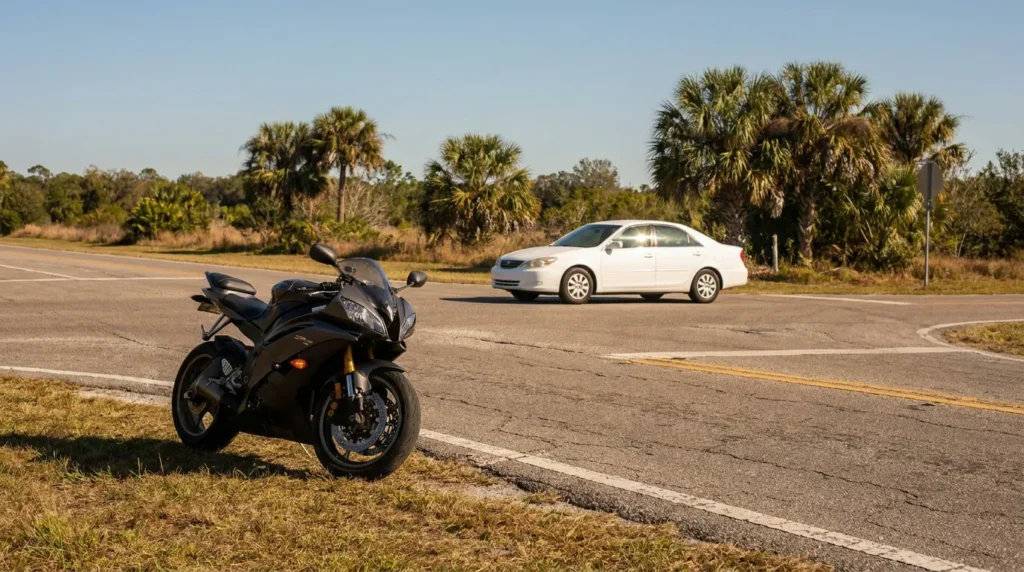
When a Driver Says "I Never Saw the Motorcycle"
Key Takeaways: Inattentional blindness is a perceptual failure where a driver looks directly at a motorcycle yet fails to register it. Under Florida law, this lapse is treated as breach of duty, not an excuse. FL Sec. 316.027(1)(b) identifies motorcyclists as vulnerable road users. Riders must prove duty, breach, causation, and damages through sight lines, scene evidence, and witness accounts. For claims accruing on or after March 24, 2023, comparative fault under Fla. Stat. § 768.81 reduces recovery by the rider’s percentage of fault and bars recovery above 50 percent. FL Sec. 316.405 limits how headlight compliance can be used against a rider. Claims accruing on or after March 24, 2023 must be filed within two years under Fla. Stat. § 95.11(5)(a).
Inattentional blindness is the perceptual failure in which a person looks directly at something yet fails to consciously register it. In a Lakeland motorcycle crash, it explains why a driver turning left can stare at an approaching rider, pull out anyway, and honestly insist the motorcycle "came out of nowhere." Under Florida negligence law, this perceptual lapse is treated as breach of duty, not an excuse.
If you were hurt because a driver looked but failed to see you, the team at Norden Leacox can help evaluate your claim. Call 407-801-3000 for a free consultation, or reach out to our team today to discuss your options with a Lakeland rider injury lawyer.
Why Inattentional Blindness Motorcycle Accidents Happen So Often
Motorcycles occupy a small slice of a driver’s visual field, and human attention is selective. Drivers scanning intersections typically search for the size, shape, and motion signature of a car. A motorcycle presents a narrow profile with a different closing-speed cue, so it can fall outside what the brain flags as relevant.
Lakeland roadway conditions make this perceptual failure more likely, including:
- Left turns across oncoming traffic at busy intersections along US 98 and Memorial Boulevard
- Lane changes and merges on I-4 where a rider sits in a shifting blind spot
- Pulling out of driveways into misjudged gaps
- Cluttered visual backgrounds where a rider blends into signage or sun glare
💡 Pro Tip: Write down exactly what the driver said at the scene. Statements like "I looked and didn’t see you" may be treated as party admissions, though admissibility is ultimately for the court to decide.
The Legal Duty Owed to Lakeland Riders
Florida law expressly recognizes motorcyclists as vulnerable road users. Under FL Sec. 316.027(1)(b), a "vulnerable road user" includes "a person operating a bicycle, an electric bicycle, a motorcycle, a scooter, or a moped lawfully on the roadway." This reflects legislative recognition that failing to perceive a visible motorcycle is a serious breach of the ordinary duty of care.
Because riders lack enclosed vehicle protection, driver perception failures frequently produce serious injuries, including traumatic brain injuries, spinal damage, and complex fractures that create "a substantial risk of death, serious personal disfigurement, or protracted loss or impairment of the function of a bodily member or organ."
Proving Breach and Causation
An inattentional blindness legal claim requires the same four elements as any negligence case: duty, breach, causation, and damages. The perceptual science explains the breach; it doesn’t replace proof. Counsel establishes sight lines, approach speeds, available reaction time, and the absence of any obstruction that would have made the motorcycle genuinely invisible.
Human factors testimony can be persuasive, but it is not automatically admitted. Expert testimony is governed by the Daubert standard codified at Fla. Stat. § 90.702. What often matters is the underlying record: scene photographs, vehicle positions, event data, and witness accounts. Our discussion of evidence in a motorcycle accident claim walks through documentation that tends to carry weight.
How Comparative Fault Shapes Motorcycle Crash Fault in Lakeland
Florida applies a modified comparative negligence system where jury percentages determine what a rider actually recovers. Under FL Sec. 768.81(2), contributory fault chargeable to the claimant "diminishes proportionately the amount awarded" for economic and noneconomic damages. FL Sec. 768.81(6) provides that, in negligence actions other than medical negligence claims, "any party found to be greater than 50 percent at fault for his or her own harm may not recover any damages." A rider found 51 percent responsible would be barred from recovering. This 50 percent bar applies to causes of action accruing on or after March 24, 2023.
That threshold is why the perception argument matters. When a defense insurer argues the rider was hard to see, the response is that the motorcycle was lawfully present and visually available, and the driver simply failed to process it. Keeping the rider’s share at or below 50 percent is often pivotal in a motorcycle accident lawyer Lakeland consultation.
| Fault Allocation | Practical Effect Under Fla. Stat. § 768.81 |
|---|---|
| Rider 0% at fault | Full damages, subject to proof |
| Rider 25% at fault | Award generally reduced by 25% |
| Rider 50% at fault | Award generally reduced by half; recovery preserved |
| Rider 51% or more | Recovery generally not permitted |
Apportionment and Blaming Non-Parties
Damages are apportioned by each party’s percentage of fault. Fla. Stat. § 768.81(3) (2024) directs the court to enter judgment against each liable party based on that party’s percentage of fault.
Defendants may shift blame onto someone not in the lawsuit, but the statute imposes a procedural check. Under Fla. Stat. § 768.81(3)(a)1.-2. (2024), a defendant must affirmatively plead the fault of a nonparty within the time allowed and prove that fault at trial by a preponderance of the evidence. The comparative fault provisions of Chapter 768 apply broadly to negligence actions.
Motorcycle Visibility Liability in Florida: The Headlight Rules
Florida requires motorcycle operators to keep their headlights on while riding, but the statute limits how that requirement can be used against a rider. FL Sec. 316.405(1) states that failure to comply "during the hours from sunrise to sunset… shall not be admissible as evidence of negligence in a civil action." For a daytime Lakeland crash, this restricts a defendant’s ability to blame the collision on headlight use.
Outside daytime hours, a violation is still not automatically fault. FL Sec. 316.405(2) provides that noncompliance "shall not be deemed negligence per se in any civil action, but the violation of this section may be considered on the issue of negligence if the violation of this section is a proximate cause of a crash." Visibility conduct may be weighed by the jury within the comparative fault analysis, but only if the defendant proves proximate causation. The Florida traffic control statutes address related equipment and roadway duties.
Deadlines That Can End a Polk County Motorcycle Injury Claim
Florida’s limitations period for negligence-based claims is generally two years. Fla. Stat. § 95.11(5)(a) (2024) provides: "WITHIN TWO YEARS., (a) An action founded on negligence." That two-year period applies to causes of action accruing on or after March 24, 2023; claims that accrued before that date generally remain subject to the prior four-year period. A rider must file within the applicable window or lose the claim entirely.
Different deadlines apply to claims against government entities, which also require presuit notice under Fla. Stat. § 768.28. Civil filing deadlines are distinct from any administrative or insurance notice requirement, which operate on separate and often shorter timelines.
Reporting the Crash
Florida law requires immediate contact with law enforcement after qualifying crashes. Section 316.065, Florida Statutes, requires drivers to contact local law enforcement for crashes involving injury or death, or at least $500 in estimated vehicle or property damage. That report is often the first document recording a driver’s statement that they did not see the motorcycle. Note that Fla. Stat. § 316.066 limits the use of crash reports themselves as evidence in civil trials, so underlying witness testimony usually remains essential.
💡 Pro Tip: Request the crash report and review it for accuracy within the first few weeks. Officer narratives sometimes summarize a driver’s admission in a way that may materially help or hurt the perception analysis.
What Damages May Be Available
Florida’s comparative fault statute frames how losses are categorized. FL Sec. 768.81(1)(b) defines "economic damages" to include past and future lost income, medical and funeral expenses, lost support and services, and replacement value of lost personal property. Noneconomic damages, including pain and suffering, are likewise reduced by any fault allocated to the rider. Because motorcycles are excluded from Florida’s no-fault PIP system under Fla. Stat. § 627.736, motorcyclists are not subject to the serious injury threshold under Fla. Stat. § 627.737(2) and may recover noneconomic damages without meeting that threshold.
Documentation drives value. Consistent medical treatment, imaging, wage records, and treating-physician opinions generally carry more weight than narrative descriptions.
Frequently Asked Questions
1. Is inattentional blindness a legal defense for the driver who hit me?
Generally, no. Florida negligence law measures conduct against a reasonable-care standard, so a driver’s failure to perceive a lawfully present motorcycle is more commonly used as evidence of breach of duty than as an excuse.
2. Can I still recover if I was partly at fault?
Under Fla. Stat. § 768.81(6), a party found greater than 50 percent at fault may not recover damages in most negligence actions accruing on or after March 24, 2023. At or below that threshold, recovery is permitted with damages reduced proportionately.
3. Does not wearing bright gear hurt my claim?
Florida law does not impose a general high-visibility clothing mandate on riders. A defendant may raise conspicuity arguments within the comparative fault framework if relevant and tied to causation.
4. How long do I have to file a Lakeland motorcycle crash lawsuit?
Fla. Stat. § 95.11(5)(a) (2024) sets a two-year period for actions founded on negligence accruing on or after March 24, 2023. Limited exceptions and different deadlines may apply, so speaking with a Lakeland motorcycle attorney early is advisable.
5. What if the driver says the sun was in their eyes?
Sun glare does not automatically excuse a collision. Drivers may be expected to adjust speed and behavior for known visibility conditions, and whether that argument reduces the driver’s fault is a fact-dependent question for the jury.
Protecting Your Recovery After a Perception-Failure Crash
Inattentional blindness may explain the "I never saw him" collision, but explanation is not excuse. Florida’s statutes recognize motorcyclists as vulnerable road users, restrict how daytime headlight compliance can be used against a rider, and allocate damages by percentage of fault under a 50 percent bar. Building a credible record early, preserving the crash report, and filing within the applicable negligence limitations period can help keep a rider’s fault share low and the claim viable.
If a driver failed to perceive you on the road, the attorneys at Norden Leacox Accident & Injury Law are prepared to investigate the crash and pursue full accountability. Call 407-801-3000 or schedule your free case review to speak with our team about your Polk County motorcycle injury claim.
Disclaimer: This content is for informational purposes only and is not legal advice. Every case is unique, and results may vary. Consult an attorney about your specific circumstances.