


Norden Leacox Accident & Injury Law | August 11, 2026 | Personal Injury
Why Fast Evidence Preservation Decides Orlando Pedestrian Crash Cases
Key Takeaways: After a mid-block pedestrian crash in Orlando, the central question is often who had the right of way and whether you can prove it. Counter an insurer’s blame-shifting by preserving evidence quickly through scene photographs, documenting vehicle positions and roadway conditions, and gathering witness information before details fade. Florida’s section 316.130 governs pedestrian conduct, but a mid-block crossing is not automatically unlawful and drivers still owe pedestrians a duty of care. Because Florida uses modified comparative negligence, a pedestrian found more than 50 percent at fault recovers nothing, so strong evidence can mean the difference between a reduced recovery and none at all. Preserved evidence must support the four negligence elements: duty, breach, causation, and damages. Securing video and third-party records fast is vital, especially in hit-and-run cases. With the negligence statute of limitations now generally two years, acting early and consulting a qualified attorney protects your rights.
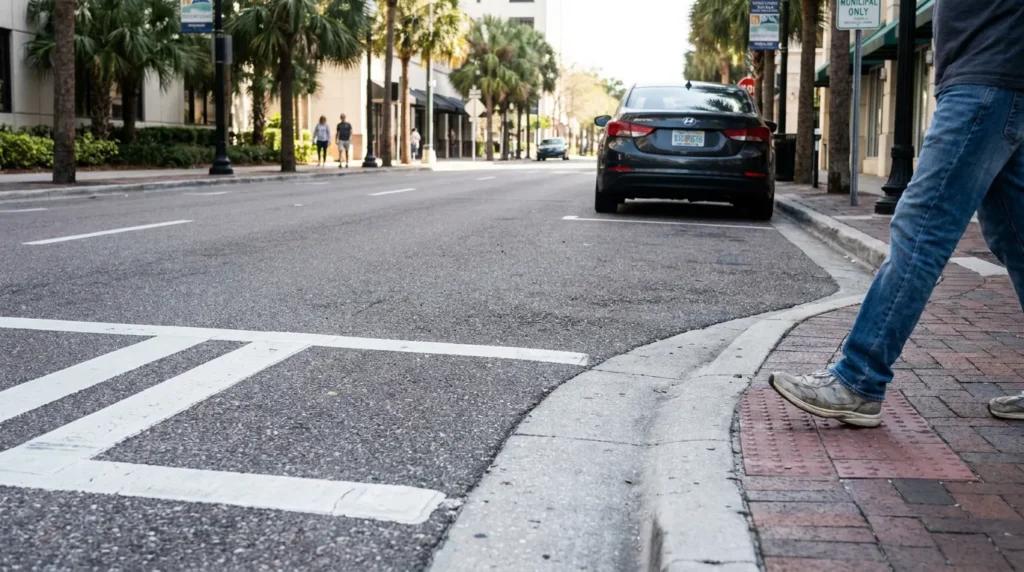
A mid-block pedestrian crash in Orlando often comes down to a single question: who had the right of way, and can you prove it? When a pedestrian is struck while crossing outside a marked crosswalk, the driver’s insurer will frequently argue the pedestrian caused the collision. The most reliable way to counter that argument is to preserve evidence quickly, before skid marks fade, video is overwritten, and witnesses forget what they saw.
If you or a loved one was hurt in a pedestrian collision, the team at Norden Leacox can help you understand your options. Call our office at 407-801-3000 to discuss what happened, or send us the details through our online case review request.
The First Minutes: Documenting the Scene Before It Changes
The scene of a crash begins changing the moment vehicles move and traffic resumes. If you are physically able, or if a trusted companion is present, capturing the scene right away preserves details that investigators and attorneys later rely on. Photographs and video taken from multiple angles can memorialize vehicle positions, roadway conditions, lighting, and signage that a written report may not fully capture.
Collect a broad record early to give your claim a stronger foundation:
- Photos of vehicle damage, final resting positions, and debris fields
- Images of the exact crossing location, including distance to the nearest intersection or crosswalk
- Skid marks, road surface conditions, and any traffic signals or signs
- The driver’s information, license plate, and any visible traffic citation
- Names and contact details for every witness at the scene
💡 Pro Tip: Photograph the surrounding area from the driver’s approach angle. This can help show what a reasonable driver should have been able to see, which is often central to proving breach of duty.
Understanding Florida Jaywalking Law 316.130 and Mid-Block Crossings
The controlling statute for pedestrian conduct is section 316.130, Florida Statutes, titled "Pedestrians; traffic regulations." This law describes the rights and duties of people on foot, including when a pedestrian must yield to vehicles while crossing outside a marked crosswalk or intersection. Because insurers frequently invoke the florida jaywalking law 316.130 to shift blame onto the injured person, preserving evidence of where and how the crossing occurred is critical. You can review the full text within the state’s uniform traffic control chapter.
"Jaywalking" is a common label, not a precise legal term. A mid-block crossing is not automatically unlawful, and even when a pedestrian was required to yield, that does not end the analysis of the driver’s responsibility. Under section 316.130, drivers still owe duties toward pedestrians, and a violation by the motorist can independently support a claim. Evidence such as the crossing point, sightlines, and vehicle speed often determines how fault is ultimately divided.
How Comparative Negligence Affects Your Recovery
Florida applies a modified comparative negligence standard, meaning fault is divided by percentage among the parties. Under section 768.81(3), Florida Statutes, a court enters judgment against each liable party based on that party’s percentage of fault. If a pedestrian is assigned some share of blame for a mid-block crossing, any recovery is reduced by that percentage.
The 2023 tort reform amendment added a significant threshold. Section 768.81(6), Florida Statutes, provides that any party found to be greater than 50 percent at fault for his or her own harm may not recover any damages, an exception that does not apply to medical negligence claims under chapter 766. This is why thorough pedestrian accident evidence in Florida matters so much, the difference between 50 percent fault and 51 percent fault can be the difference between a reduced recovery and no recovery at all. Photos, video, witness statements, and crash reports can all work to lower the fault percentage attributed to the injured pedestrian.
Proving Negligence: The Four Elements Your Evidence Must Support
A pedestrian injury claim ultimately rises or falls on proving negligence, so preserved evidence must support each required element. In a negligence case, the injured party generally must establish duty, breach, causation, and damages. Understanding these elements early helps clarify why documenting the scene is the backbone of a claim.
Each element connects to specific proof that evidence preservation can supply:
| Element | What It Means | Evidence That Helps |
|---|---|---|
| Duty | The driver owed reasonable care | Statutory duties under section 316.130 |
| Breach | The driver was careless | Speeding, citations, dashcam video |
| Causation | The breach caused the injury | Crash reconstruction, scene photos |
| Damages | Actual harm occurred | Medical records, bills, wage loss proof |
Evidence of a traffic-law violation by the driver can also strengthen a claim through negligence per se. This doctrine can be triggered when someone violates a safety law and helps establish the duty and breach elements. That is one reason preserving citations, signal timing, and roadway evidence carries real weight in a pedestrian injury claim.
When the Driver Flees: Hit-and-Run Pedestrian Crashes
Hit-and-run collisions are alarmingly common in Florida and can be especially dangerous for pedestrians. According to the Florida Highway Safety and Motor Vehicles agency, there were over 104,000 hit-and-run crashes statewide in 2023, resulting in more than 270 fatalities and over 800 serious bodily injuries.
Pedestrians bear a disproportionate share of the harm in these fleeing-driver cases. Of the 271 hit-and-run fatalities in 2023, roughly three-quarters involved pedestrians and bicyclists, according to state figures reported on the agency’s hit-and-run awareness resources. If a driver flees, witnesses and nearby surveillance video become even more valuable, since they may be the only way to identify the responsible party.
💡 Pro Tip: If you have information about a hit-and-run, you can report it to the Florida Highway Patrol or anonymously through Florida Crime Stoppers. Quick reporting helps investigators preserve evidence before it disappears.
Securing Video and Third-Party Records Quickly
Video evidence is often decisive, but it does not last forever. Many businesses, doorbell cameras, and traffic systems overwrite footage within days or weeks. Sending prompt preservation requests, or having an attorney do so, can help secure recordings before they are lost. For a deeper look at how different records fit together, our overview of the evidence that strengthens a pedestrian accident claim explains what typically carries weight.
Why the Clock Matters: Deadlines to Preserve Your Rights
Florida law limits how long an injured person has to file a civil negligence lawsuit, and that window has narrowed. Under the 2023 HB 837 amendment to section 95.11, Florida Statutes, the statute of limitations for most negligence claims was reduced from four years to two years for causes of action accruing on or after March 24, 2023. This shortened deadline makes rapid evidence collection even more important.
Certain limited exceptions may affect these deadlines, but courts generally interpret them narrowly. Tolling and delayed-discovery arguments do not apply automatically and depend heavily on the specific facts. Because outcomes here are fact-sensitive, confirming any applicable deadline with a qualified attorney is the safest approach.
Building Your Claim With Experienced Guidance
Preserving evidence is only the first step, and interpreting that evidence within Florida’s fault rules takes careful legal analysis. An attorney can evaluate the crossing location, gather witness accounts, and work to counter comparative-fault assertions from insurers. Working with an Orlando pedestrian lawyer who handles these cases can help align your documentation with what the law requires to prove liability.
No two mid-block crossing cases in Orlando are identical, and results depend on the specific facts. A trusted advocate can help quantify economic losses like medical bills and lost income, as well as non-economic harm such as pain and suffering.
Frequently Asked Questions
1. Does crossing mid-block automatically mean I cannot recover damages?
No. Crossing outside a crosswalk does not automatically bar recovery. Under section 768.81, Florida Statutes, your damages may be reduced by your percentage of fault, and you generally recover nothing only if you are found more than 50 percent at fault.
2. What evidence is most important after a pedestrian crash?
Scene photos, surveillance or dashcam video, witness contact information, the crash report, and medical records all help. Evidence showing the driver’s speed, citations, or traffic violations can be particularly valuable for proving breach.
3. How long do I have to file a claim in Florida?
For most negligence claims accruing on or after March 24, 2023, the deadline is generally two years under section 95.11, Florida Statutes. Limited exceptions may apply, but courts interpret them narrowly, so prompt action is wise.
4. What should I do if the driver left the scene?
Preserve any details you noticed, seek witnesses, and report the incident to law enforcement promptly. Because hit-and-run cases often depend on video and third-party accounts, securing that evidence quickly can be essential.
5. Can I still have a claim if I was partly at fault?
Often, yes. Florida’s modified comparative negligence rule allows recovery when you are 50 percent or less at fault, though your award is reduced by your share. Strong evidence can help lower the fault attributed to you.
Protecting Your Case Starts With the Right First Steps
A mid-block pedestrian crash can be overwhelming, but the actions you take early often shape the outcome. By documenting the scene, securing video, identifying witnesses, and understanding how the florida jaywalking law 316.130 and comparative negligence rules apply, you place yourself in a far stronger position. Evidence preservation is the foundation that supports every element of a pedestrian injury claim.
If you are ready to protect your rights, the attorneys at Norden Leacox are prepared to review the details and help you move forward. Call 407-801-3000 today or reach out through our confidential contact form to schedule a consultation and take the next step toward protecting your claim.