


Norden Leacox Accident & Injury Law | October 7, 2026 | Truck Accidents
Merging Trucks, Blind Spots, and Your Right to Compensation on I-4
Key Takeaways: When a truck merges into your car on I-4 in Orlando, the truck driver is often the main party at fault, but the trucking carrier, the truck’s owner or lessor, maintenance providers, and cargo loaders may also share liability. Blind spots generally don’t excuse a commercial driver’s duty to make sure a lane is clear before changing lanes. Owners and lessors may be protected by liability caps under Fla. Stat. § 324.021(9)(b), but those caps generally don’t apply to their own negligence. Under Florida’s modified comparative fault rule, your damages may be reduced by your share of fault, and you generally can’t recover if you’re found more than 50 percent at fault. Most negligence claims from crashes on or after March 24, 2023, generally must be filed within two years, and tolling exceptions are narrow. Evidence like ELD data, dashcam footage, and maintenance records can disappear quickly, so act fast to preserve it.
When a truck merges into your car on I-4 in Orlando, the truck driver is often the first party courts look at, but they may not be the only one responsible. The driver, the trucking company, the truck’s owner or lessor, and sometimes a maintenance provider or cargo loader could share liability. Florida’s comparative fault rules, owner liability caps, and a two-year filing deadline can all affect how much you may recover and when you must act.
If a merging truck left you injured, Norden Leacox can review what happened and explain your options. Call 407-801-3000 or contact us now to talk about your case.
Why Merging Truck Collisions Happen So Often on I-4
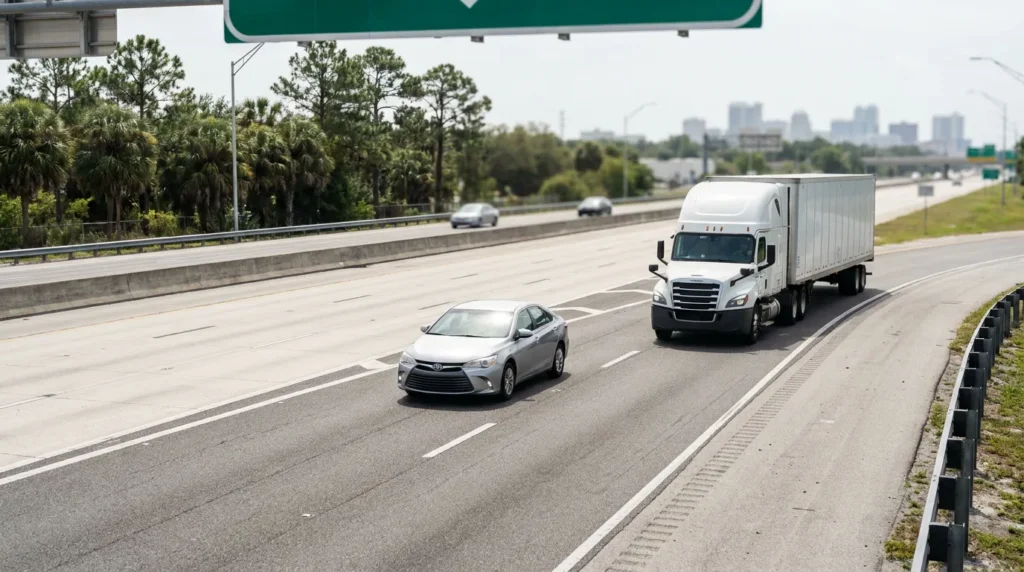
Merging collisions often happen because a tractor-trailer has large blind spots and needs a lot of room to change lanes. On a crowded stretch of I-4 through downtown Orlando, with frequent exits, construction zones, and tourist traffic, a driver who fails to check mirrors or signal early can push into an occupied lane within seconds.
Blind spots generally do not excuse a truck driver’s duty to change lanes safely. Under Fla. Stat. § 316.085 and § 316.089, drivers generally may not move out of a lane until they have made sure the move can be made safely, and a car in a "no-zone" does not automatically put the fault on its driver. Where a crash came from a rushed or unsignaled lane change, the case often turns on showing that the driver could have seen the car with reasonable care.
How Florida Law Frames a Truck Blind Spot Accident Claim
Florida generally treats a claim against a truck driver or trucking company as a "negligence action." Under Fla. Stat. § 768.81(1)(c), that term includes civil actions for damages based on negligence, strict liability, products liability, and similar theories. This brings the case under Florida’s comparative fault statute, which controls how fault is divided and how damages are reduced.
The Four Elements You Must Prove
To recover, an injured driver generally has to prove four elements: duty, breach, causation, and damages. Every motorist owes others a duty of reasonable care, and commercial drivers must also follow federal and state safety rules. You would need to show that the driver breached that duty, for example by merging unsafely, that the breach caused the collision, and that you suffered real losses such as medical bills, lost wages, and pain and suffering. Florida’s no-fault (PIP) law generally requires a permanent injury, or another threshold under Fla. Stat. § 627.737(2), before you can recover pain and suffering damages from an at-fault driver.
Unsafe Lane Changes and Aggressive Careless Driving
Florida’s traffic code may help establish truck driver negligence in a merge crash. Fla. Stat. § 316.1923 defines "aggressive careless driving" as committing two or more listed acts at the same time or one after another, including speeding, unsafely changing lanes, following too closely, and failing to yield. Under Fla. Stat. § 316.650(9), the traffic citation itself is generally not admissible at trial, but under Florida case law the underlying conduct may be shown as evidence of negligence, not automatic proof of it. Still, proof that a driver combined an unsafe lane change with speeding or tailgating may strengthen the argument.
Who May Share Liability for an I-4 Truck Crash
Liability in a merging truck collision often reaches past the person behind the wheel. For a closer look, read our guide on liable parties in truck crashes.
| Potentially Liable Party | How They May Be Responsible |
|---|---|
| Truck driver | Unsafe lane change, failure to check mirrors, distraction, fatigue |
| Trucking carrier | Vicarious liability for drivers acting within the scope of employment, plus negligent hiring, training, or supervision |
| Owner or lessor | Owner liability under Florida’s dangerous instrumentality doctrine (subject to statutory caps) and its own negligence |
| Maintenance provider | Faulty mirrors, lights, or signals that contributed to the merge |
| Cargo loader or manufacturer | Shifting loads or defective parts affecting control |
Leasing Companies and Owner Liability Caps
When a leasing company or a separate entity owns the truck, Florida law may cap that owner’s liability. Under Fla. Stat. § 324.021(9)(b)2., the lessor of a motor vehicle leased for less than one year is treated as the owner only up to $100,000 per person and $300,000 per incident for bodily injury, plus $50,000 for property damage. If the lessee or operator carries less than $500,000 in combined coverage, the lessor may face up to an additional $500,000 in economic damages. Different rules apply to longer leases. These limits do not affect a lessor’s liability for its own negligence, such as poor maintenance or negligent entrustment. The federal Graves Amendment, 49 U.S.C. § 30106, may also shield commercial lessors from purely vicarious liability when they are not negligent.
💡 Pro Tip: Ask for the full lease and insurance documents early on. The name painted on the truck’s door may not be the company that legally owns or insures it.
Roadside Inspections and Compliance Records
Records from commercial vehicle inspections may show that a carrier had safety problems before the crash. Under Fla. Stat. § 316.302, authorized officers may stop commercial vehicles and inspect the vehicle or the driver’s records. A history of violations involving mirrors, brakes, or hours-of-service rules may support claims against the carrier as well as the driver, though admissibility depends on the facts.
How Comparative Fault Can Affect Your I-4 Accident Claim
Florida uses a modified comparative fault system, and it can reduce or eliminate your recovery. Under Fla. Stat. § 768.81(6), a party found more than 50 percent at fault for their own harm generally cannot recover any damages. This bar does not apply to medical negligence actions. If your share of fault is 50 percent or less, your damages are generally reduced by that percentage. You can read Florida’s comparative fault statute for more detail.
Insurers for trucking companies often argue that the car driver was speeding, lingering in a blind spot, or failing to brake. Shifting even a modest amount of blame can shrink an award, and crossing the 50 percent line generally bars recovery entirely. Strong evidence about the truck’s movements is often key.
Older case law reflects rules that have since changed. In Walt Disney World Co. v. Wood, 515 So. 2d 198 (Fla. 1987), the Florida Supreme Court held that joint and several liability survived comparative negligence. The Legislature later largely abolished joint and several liability in Fla. Stat. § 768.81, so each defendant generally pays only its own share of fault, and in 2023 added the 50 percent bar. Wood is historical background, not current law on those points.
Evidence That Can Make or Break a Truck Merge Injury Case
Evidence in a truck crash can disappear quickly, so preserving it early is critical. Trucking companies control much of the key data, and some records may be overwritten or discarded. Federal rules, for example, generally require carriers to keep hours-of-service records for only six months. A prompt preservation demand may help keep that evidence available.
Important evidence often includes:
- Electronic logging device (ELD) and event data recorder (EDR) data showing speed, braking, and steering
- Driver logbooks and hours-of-service records
- Maintenance and inspection records for mirrors, signals, and brakes
- Dashcam, traffic camera, and nearby business video from I-4
- Witness statements and the official crash report
- Photos of vehicle damage, lane position, and road conditions
💡 Pro Tip: Write down your memory of the crash within a day or two, including which lane you were in, whether the truck signaled, and where its cab was relative to your car.
Florida’s Filing Deadlines for Orlando Highway Truck Crash Claims
Most negligence claims arising from crashes on or after March 24, 2023, generally must be filed within two years. Florida’s 2023 tort reform (HB 837) shortened the general negligence deadline in Fla. Stat. § 95.11 from four years to two. Claims that accrued before that date generally keep the old four-year period. Wrongful death claims also generally carry a two-year period. You can review the current Florida limitations statutes to confirm the applicable paragraph.
The clock generally starts on the date of the collision. Under Fla. Stat. § 95.031(1), the period runs from when the cause of action accrues. For most crashes, that is the day of impact. For wrongful death claims, it is generally the date of death.
Limited Tolling Exceptions
Florida allows the deadline to be paused only in narrow, specific situations. Fla. Stat. § 95.051 lists the circumstances that can toll a limitations period, including the defendant’s absence from the state, use of a false name that prevents service, concealment within Florida, and certain cases of minority or adjudicated incapacity. Courts read these exceptions narrowly, so it is safest to assume tolling will not apply to you. Claims involving government-owned vehicles carry separate rules. Under Fla. Stat. § 768.28, you generally must give written notice within three years and meet other pre-suit requirements, and damages are capped.
Frequently Asked Questions
1. Is the truck driver automatically at fault if they merged into me?
No. A merging truck is often strong evidence of negligence, but fault depends on the facts, including speed, signaling, lane position, and the conduct of both drivers.
2. Can I still recover if I was partly at fault?
Possibly. Under Fla. Stat. § 768.81(6), you may recover reduced damages if you are 50 percent or less at fault. If you are found more than 50 percent at fault, you generally cannot recover.
3. Can I sue the trucking company and not just the driver?
In many cases, yes. Carriers may be liable for their drivers’ actions within the scope of employment or for their own negligence in hiring, training, supervision, or maintenance.
4. How long do I have to file an I-4 accident claim?
Generally two years from the crash for negligence claims that accrued on or after March 24, 2023, under Fla. Stat. § 95.11. Tolling is available only in limited circumstances, and claims against government entities have separate notice requirements.
5. What compensation might be available?
Depending on the facts, damages may include medical expenses, lost income, property damage, and non-economic losses such as pain and suffering, which may depend on meeting Florida’s no-fault injury threshold. Punitive damages are available only in limited circumstances.
Protecting Your Rights After a Merging Truck Crash
Liability after a truck blind spot accident on I-4 can involve the driver, the carrier, the owner, and others, and each may be subject to different Florida rules. Comparative fault under Fla. Stat. § 768.81, lessor caps under Fla. Stat. § 324.021, and the two-year deadline in Fla. Stat. § 95.11 can all affect your claim. Talking with an experienced truck accident attorney can help you understand how these rules apply to your situation.
The team at Norden Leacox is ready to review your truck merge crash and help you understand your next steps. Call 407-801-3000 or schedule your consultation today, before important evidence and deadlines slip away.
Disclaimer: This content is for informational purposes only and is not legal advice. Every case is unique, and results may vary. Consult an attorney about your specific circumstances.