


Norden Leacox Accident & Injury Law | August 29, 2026 | Personal Injury
When a Crossing Mistake Meets Florida’s Fault Rules
Key Takeaways: A jaywalking pedestrian in Orlando is not automatically barred from recovering compensation. Florida’s modified comparative negligence system allows recovery when you are 50 percent or less at fault, with damages reduced by your assigned share. Florida jaywalking law 316.130 defines lawful crossing duties, but a violation does not erase the driver’s duty to use due care and avoid colliding with pedestrians. The most damaging mistakes inflate your fault above 50 percent: failing to document the scene, giving unguarded statements to adjusters, delaying medical care, ignoring the driver’s duties, and missing the filing deadline under Florida Statute 95.11. Counter the defense’s attempt to shift fault, since a defendant must affirmatively plead and prove nonparty fault by a preponderance of the evidence. Preserving evidence early and establishing the driver’s causal role are essential. Acting promptly with informed guidance gives an injured pedestrian the strongest footing.
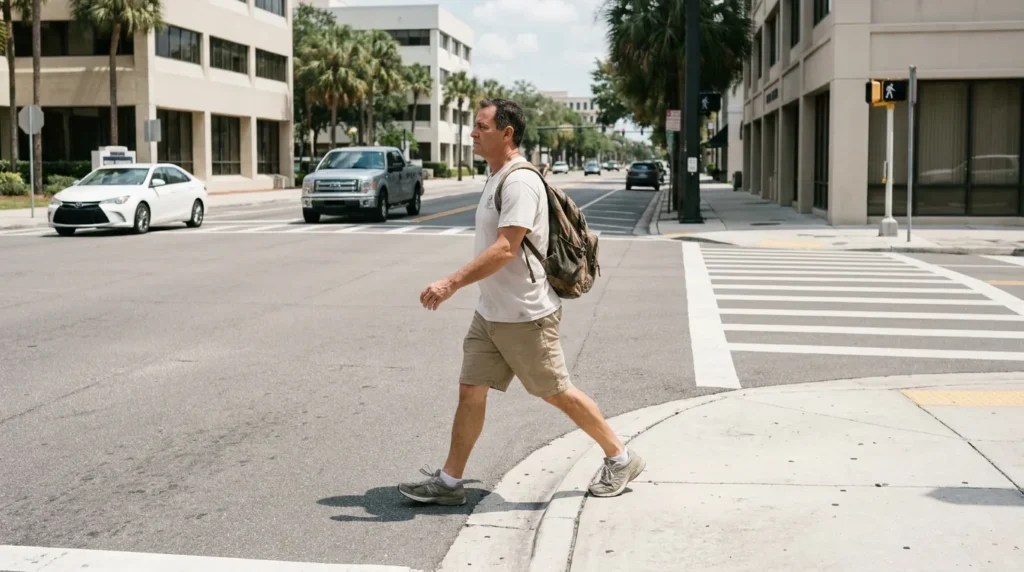
A jaywalking pedestrian in Orlando is not automatically barred from recovering compensation, but certain missteps can seriously weaken the claim. Florida places duties on people who cross outside designated areas, yet also requires drivers to use due care. The result is a fault-sharing analysis where small decisions after a crash can shift the balance and reduce, or eliminate, recovery.
Understanding how fault is measured is the first step toward protecting your rights. Whether you crossed mid-block or stepped off against a signal, the law weighs your conduct against the driver’s, and avoidable errors often do more damage than the crossing itself.
If you were hurt while walking, the team at Norden Leacox can help you understand your options. Call our office at 407-801-3000 or reach out through our online case review form to discuss what happened.
Understanding Florida Jaywalking Law 316.130
Florida jaywalking law 316.130 is the central statute governing how and where pedestrians may lawfully cross a roadway. This provision sets out the duties that, when broken, form the basis of a jaywalking allegation. A claim is often weakened when the injured person crossed outside a marked crosswalk or against a signal.
The statute covers a range of pedestrian conduct. Under Florida’s pedestrian traffic regulations in Chapter 316, Section 316.130 addresses crosswalk use, obedience to signals, and yielding responsibilities. A violation gives the defense an argument that fault belongs to the pedestrian.
Importantly, a crossing violation does not erase the driver’s legal duties. Even when a pedestrian crosses improperly, Section 316.185 requires a driver to decrease speed when special hazards exist with pedestrians and to slow "as may be necessary to avoid colliding with any person" entering the street. Section 316.130(15) separately directs every driver to exercise due care to avoid colliding with any pedestrian. A violation resulting from vehicle operation is a noncriminal traffic infraction, which is why a jaywalking pedestrian is not automatically barred. The driver’s failure to use due care can shift fault back to the motorist.
How Comparative Negligence Shapes a Pedestrian Claim
Florida uses a modified comparative negligence system that directly controls how much a partially at-fault pedestrian can recover. The 2023 reforms moved the state away from pure comparative negligence, meaning the fault assigned to you now carries far greater consequences. This shift is the single most important backdrop to any jaywalking claim.
Under the current standard, a fault threshold can bar recovery entirely. According to Section 768.81(6) in Chapter 768, any party found greater than 50 percent at fault for their own harm may not recover damages, with a narrow medical negligence exception under Chapter 766. An Orlando pedestrian who jaywalked can still recover if found 50 percent or less at fault. Above that line, the claim is eliminated.
When recovery is allowed, damages are reduced by your percentage of fault. Section 768.81(3) directs that the court enter judgment against each party liable based on that party’s percentage of fault, not on joint and several liability. A pedestrian found 30 percent responsible sees a recovery reduced by that 30 percent. To see how these principles interact in practice, review a plain-language explanation of Florida’s comparative negligence rules before an insurer frames the narrative.
The doctrine prevents defendants from paying for harm they did not cause. A negligent defendant can plead and prove that another party or nonparty caused part of the injury. This principle cuts both ways, which is why establishing the driver’s proportion of fault is central to a pedestrian’s case.
Common Errors That Undermine an Orlando Pedestrian Claim
Several avoidable mistakes tend to inflate a pedestrian’s assigned fault above the critical 50 percent line. Because fault apportionment turns on each party’s causal role in producing the injury, evidence of what happened carries enormous weight. Errors that muddy that evidence often do the most harm.
The following pedestrian fault errors commonly weaken a claim:
- Failing to document the scene, leaving the driver’s causal role unproven and letting the insurer assign more fault to the pedestrian.
- Giving unguarded statements to an adjuster that appear to admit careless crossing, which can push your percentage higher.
- Delaying medical care, creating gaps that insurers argue break the causal chain between the crash and injuries.
- Ignoring the driver’s duties under traffic laws, rather than showing how the motorist failed to slow or yield as required.
- Missing the filing deadline, which can permanently close the door regardless of how strong the facts are.
Another frequent misstep is failing to counter the defense’s fault allocation. The statute lets a defendant driver shift fault onto the pedestrian or a nonparty, but Section 768.81(3)(a) requires that defendant to affirmatively plead nonparty fault and prove it at trial by a preponderance of the evidence. When a claimant does not challenge that allocation, the defense narrative can go unanswered.
Timing errors can be the most unforgiving. Personal injury negligence claims are governed by Florida’s civil limitations statute, and missing that window generally bars the claim outright. Treating the schedule casually is a risk no injured pedestrian should take.
Why Deadlines Deserve Early Attention
Florida Statute 95.11 sets the time limits for filing most civil actions, including personal injury negligence claims. The limitations period for negligence actions was shortened by the 2023 reforms to two years for causes of action accruing on or after March 24, 2023. Courts generally interpret any tolling or discovery-based exceptions narrowly and apply them only in limited circumstances. Do not assume delays will be excused.
Administrative traffic matters are separate from your civil claim. A traffic citation issued to a driver or pedestrian is handled through the traffic system and does not resolve or replace a civil lawsuit for damages. Keeping these tracks distinct helps you avoid assuming one outcome dictates the other.
💡 Pro Tip: Ask for the responding officer’s crash report number at the scene or shortly after. That single document often anchors the causation evidence that keeps a pedestrian’s assigned fault below the 50 percent threshold.
Protecting Your Right to Recover After a Crossing Injury
Building a strong pedestrian injury claim means proactively documenting the driver’s share of causal fault. Because apportionment is a straightforward inquiry into each party’s role in causing damages, evidence you preserve early shapes the entire case. Photographs, witness contact information, and prompt medical records all help establish the full picture.
The evolution of Florida’s apportionment rules explains why this evidence matters so much today. Florida shifted from joint and several liability to a comparative fault approach, so damages in negligence cases are apportioned according to each party’s percentage of fault. That older joint and several liability doctrine still controls causes of action that accrued before the statute’s effective date.
Knowledgeable guidance helps you respond to comparative-fault tactics. An Orlando pedestrian accident attorney can gather evidence, quantify losses, and press the point that a driver should not escape responsibility for harm the driver helped cause. A measured, evidence-first approach gives an injured pedestrian the strongest footing.
| Pedestrian’s Assigned Fault | General Effect on Recovery |
|---|---|
| 50% or less | Recovery allowed, reduced by fault percentage |
| Greater than 50% | Recovery generally barred under Section 768.81(6) |
Frequently Asked Questions
-
Does jaywalking automatically bar my Orlando pedestrian claim?
No, jaywalking alone does not end a claim. Florida applies modified comparative negligence, so you can generally recover if found 50 percent or less at fault, with damages reduced by your share. A driver’s failure to use due care can shift fault back to the motorist.
-
What is the fault threshold that eliminates recovery?
Under Section 768.81(6), a party found greater than 50 percent at fault for their own harm may not recover damages. This is why avoiding mistakes that inflate your assigned fault is critical. A narrow medical negligence exception exists under Chapter 766.
-
How does Florida Statute 316.130 affect my case?
Florida jaywalking law 316.130 defines lawful crossing duties, and a violation gives the defense an argument for pedestrian fault. It does not override the driver’s own duties under traffic laws. Both parties’ conduct is weighed together.
-
Is there a deadline to file a pedestrian injury lawsuit?
Yes, Florida Statute 95.11 sets the limitations period for negligence claims, and missing it generally bars the case. For causes of action accruing on or after March 24, 2023, that period is generally two years. Any tolling or discovery exceptions are read narrowly and apply only in limited circumstances. Acting promptly protects your rights.
-
Can the driver blame a nonparty for the crash?
Yes, but Section 768.81(3)(a) requires the defendant to plead and prove nonparty fault by a preponderance of the evidence. Unanswered, that allocation can raise your percentage. Countering it with facts is essential.
Moving Forward With Confidence
A jaywalking crossing does not have to define the outcome of your Orlando pedestrian accident claim. Florida’s modified comparative negligence system keeps the door open when you are 50 percent or less at fault, but the mistakes discussed here can push your assigned fault higher and reduce what you recover. Preserving evidence, respecting deadlines, and countering the defense’s fault allocation protect an injury claim. Every case turns on its own facts, so early, informed action matters.
If you or a loved one was hurt while walking in Central Florida, the attorneys at Norden Leacox are ready to review your situation. Call 407-801-3000 today or request a consultation through our secure contact page to learn how Florida’s fault rules may apply to your pedestrian injury claim.