


Norden Leacox Accident & Injury Law | October 29, 2026 | Truck Accidents
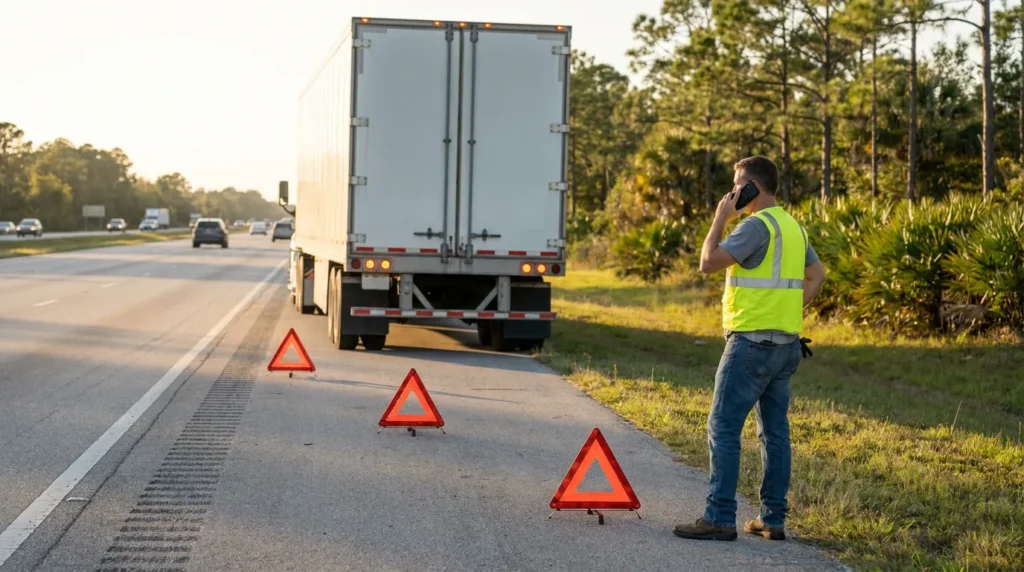
Florida Truckers and Phones: The Emergency Rule Is Narrow
Key Takeaways: In Florida, a trucker may generally use a hand-held phone while driving only when needed to contact law enforcement or other emergency services, under 49 C.F.R. §§ 392.80 and 392.82. Florida applies these federal rules to interstate and most intrastate haulers through Fla. Stat. § 316.302, and state law preempts local governments from regulating in-vehicle phone use. Dispatcher calls, delivery updates, personal calls, and hand-held navigation generally do not count as emergencies, and the only added Florida carve-out covers utility drivers during declared emergencies. Violations can bring federal civil penalties and, for repeat offenses, CDL disqualification. A violation may serve as evidence of negligence in a crash claim, but victims generally still need to prove the phone use contributed to their injuries. Because evidence can disappear quickly and Florida generally sets a two-year filing deadline for negligence claims, acting early is important.
Under federal rules that apply in Florida, a trucker may generally use a hand-held phone while driving only when needed to contact law enforcement or other emergency services. Commercial drivers in Lakeland and across the state must follow 49 C.F.R. § 392.82, which bans hand-held phone use while driving a commercial motor vehicle (CMV), and 49 C.F.R. § 392.80, which bans texting. Each rule contains a limited emergency exception. A stressful moment, a dispatcher call, or a late delivery generally does not count as an emergency.
If a distracted truck driver injured you or someone you love, you should not have to sort out federal and state phone rules alone. The team at Norden Leacox can review what happened and explain your options. Call 407-801-3000 or contact us now to talk about your case.
How Federal Phone Rules Reach Florida Truck Drivers
Florida adopts the federal trucking safety rules for most commercial vehicles on its roads. Under Fla. Stat. § 316.302(1), commercial motor vehicles in interstate commerce, and most in intrastate commerce (as the federal rules existed on December 31, 2023), are subject to 49 C.F.R. parts 382-386 and 390-397. Those parts include the hand-held phone and texting bans in Part 392 (§§ 392.80 and 392.82). A local hauler driving only between Lakeland and Tampa generally faces the same phone limits as a long-haul trucker.
Florida also sets the rules for who needs a commercial driver license. Under Fla. Stat. § 322.53(1), anyone who drives a commercial motor vehicle in Florida generally must hold a valid commercial driver license (CDL), with limited exemptions. The related traffic and commercial vehicle rules are in Chapter 316.
Local Ordinances Cannot Change the Rules
Lakeland and other Florida cities generally cannot write their own phone-use rules for drivers. Fla. Stat. § 316.0075 expressly preempts to the state the regulation of drivers’ and passengers’ use of mobile phones and other electronic communication devices in vehicles.
What the Truck Driver Hand-Held Phone Ban Prohibits
The ban generally forbids holding a phone to talk, dialing by pressing more than one button, or reaching for a phone in a way that takes the driver out of a normal seated, belted position. It applies while driving, including when the truck is briefly stopped in traffic or at a light. It does not apply when the driver has pulled off the road and stopped where it is safe to stay stopped. Federal rules generally allow hands-free use, such as a phone mounted near the driver that starts a call with a single touch or a voice command. Texting while driving is banned separately under 49 C.F.R. § 392.80. Motor carriers are also barred from requiring or allowing their drivers to break these rules.
Regulators treat phone use as a serious hazard for good reason. NHTSA’s distracted driving research defines distracted driving as any activity that pulls attention away from driving, including talking or texting on a phone. At 55 mph, reading or sending a text can take a driver’s eyes off the road for about five seconds, long enough to cover a football field.
Florida’s Civil Penalties for Violations
Violations can bring civil penalties and loss of CDL privileges. Drivers who break 49 C.F.R. § 392.80 or § 392.82 can face federal civil penalties of several thousand dollars per violation, and carriers face higher maximums. Under 49 C.F.R. § 383.51, which Florida enforces through its CDL laws, a second conviction within three years can bring a 60-day disqualification, and a third can bring a 120-day disqualification. These penalties are separate from a civil injury lawsuit, though a citation may still be useful evidence.
When the Emergency Exception Phone Ban Rule Applies
The emergency exception generally covers only communication needed to reach law enforcement or other emergency services. Under 49 C.F.R. § 392.82, a driver may use a hand-held phone when necessary to talk with police, fire, EMS, or similar responders. The texting rule in § 392.80 has a parallel exception. The exception is tied to the purpose of the call, not the driver’s stress level or schedule.
Several common excuses generally fall outside FMCSA emergency use. These may include:
- Calling a dispatcher about a delay or route change
- Checking a delivery app or load board
- Answering a personal or family call while driving
- Texting a broker or shipper about arrival times
- Using a hand-held phone for navigation
Even when the exception applies, safer choices may exist. A driver who can safely pull over before calling 911 may be expected to do so. Whether an emergency call was truly "necessary" can become a fact-driven question in litigation.
The Florida Utility Driver Carve-Out
Florida extends the federal emergency exception to one narrow group. Fla. Stat. § 316.3025 applies the exceptions in 49 C.F.R. § 392.82 to communications between utility drivers and utility contractor drivers during a Level 1 activation of the State Emergency Operations Center or a state of emergency declared by the Governor. It does not appear to create a general emergency exception for freight haulers.
How This Differs From Rules for Regular Drivers
Non-commercial drivers in Florida have broader exceptions under a separate statute. Fla. Stat. § 316.306(3)(b) allows drivers to report emergencies or suspicious activity to police and to receive safety-related alerts, and permits some other uses, like navigation. Truckers generally must meet the stricter federal CMV standards.
| Issue | Commercial Truck Drivers | Non-Commercial Drivers |
|---|---|---|
| Main rule | 49 C.F.R. §§ 392.80, 392.82 via Fla. Stat. § 316.302 | Fla. Stat. §§ 316.305, 316.306 |
| Hand-held calls | Generally prohibited | Restricted in school and active work zones |
| Emergency exception | Contacting law enforcement or emergency services | Reporting emergencies, receiving safety alerts, and more |
| Special carve-out | Utility drivers during declared emergencies | Not applicable |
| Penalties | Federal civil penalties; possible CDL disqualification for repeat violations | Traffic citation penalties |
💡 Pro Tip: If a trucker claims they were calling 911, phone records can show the number dialed, the time, and how long the call lasted.
Building a Distracted Trucker Claim After a Florida Truck Accident
A distracted trucker claim generally requires proof of duty, breach, causation, and damages. Under Florida law, breaking a safety rule like § 392.82 is generally treated as evidence of negligence. It does not automatically prove negligence or that the violation caused the crash. You still generally need to show that the phone use contributed to the collision and your injuries.
Evidence of phone use can disappear quickly. Useful evidence may include cell phone records, ELD and engine control module data, dash camera and in-cab video, dispatch messages, witness statements, and police reports. Knowing what evidence truck crash victims need can help you act before records are erased or overwritten. A preservation letter sent early may help protect this data.
More Than One Party May Be Liable
The driver is often not the only responsible party in a Florida truck accident. A motor carrier may be liable for its driver’s conduct within the scope of employment, or for its own policies, such as pushing drivers to answer dispatch calls on the road. Cargo loaders or manufacturers may also share fault.
💡 Pro Tip: Keep a written record of everything you remember, such as whether the driver looked down or held a phone near their ear.
Florida Deadlines and Fault Rules That Can Affect Recovery
Florida generally gives injured people two years to file a negligence lawsuit. Under Fla. Stat. § 95.11(5)(a), as changed by HB 837 in 2023, most negligence claims accruing after March 24, 2023, must be filed within two years. Claims against government entities also carry separate pre-suit notice requirements under Fla. Stat. § 768.28.
Florida’s modified comparative fault rule may also reduce or bar recovery. Under Fla. Stat. § 768.81(6), an injured person found more than 50 percent at fault generally cannot recover damages in most negligence cases. If you are 50 percent or less at fault, your award is reduced by your share. Insurers sometimes try to shift blame to victims, which makes strong evidence of the trucker’s distraction especially important.
Frequently Asked Questions
1. Can a truck driver in Florida use a hands-free phone?
Generally, yes. Federal rules generally allow hands-free use if the phone is close by and the driver can start or answer a call with a single touch or a voice command. Texting while driving remains prohibited, except to contact emergency services when necessary.
2. Does calling dispatch about a road hazard count as an emergency?
In many cases, no. The federal exception covers communication needed to reach law enforcement or other emergency services. A call to dispatch generally falls outside that exception.
3. If the trucker got a phone-use citation, does that prove my case?
Not on its own. A citation may be strong evidence of negligence, but you generally still need to show the phone use contributed to the crash and your injuries.
4. How can I prove a truck driver was on the phone?
Common sources include phone carrier records, in-cab camera footage, ELD data, dispatch logs, and eyewitness accounts. Many of these records may require a subpoena or discovery request, and some may be lost if not preserved early.
5. Can the trucking company be held responsible?
Under certain circumstances, yes. Carriers may be liable for their drivers’ negligence within the scope of employment, and they may face direct liability if their policies encouraged unsafe phone use.
Protecting Your Rights After a Distracted Truck Crash
Florida truckers generally may use a hand-held phone while driving only to reach law enforcement or emergency services, with a narrow added exception for utility drivers during declared emergencies. When a trucker ignores these rules and causes a crash, evidence of phone use may play a central role in holding the driver and carrier accountable. Acting early to preserve records and meet Florida deadlines is important.
If you are dealing with injuries after a crash with a distracted commercial driver, a truck driver hand-held phone ban lawyer can help you understand your options. Norden Leacox represents injured people and families across Florida, including Lakeland. Speak with a truck driver hand-held phone ban lawyer by calling 407-801-3000 or schedule your consultation today.
Disclaimer: This content is for informational purposes only and is not legal advice. Every case is unique, and results may vary. Consult an attorney about your specific circumstances.