


Norden Leacox Accident & Injury Law | September 6, 2026 | Car Accidents
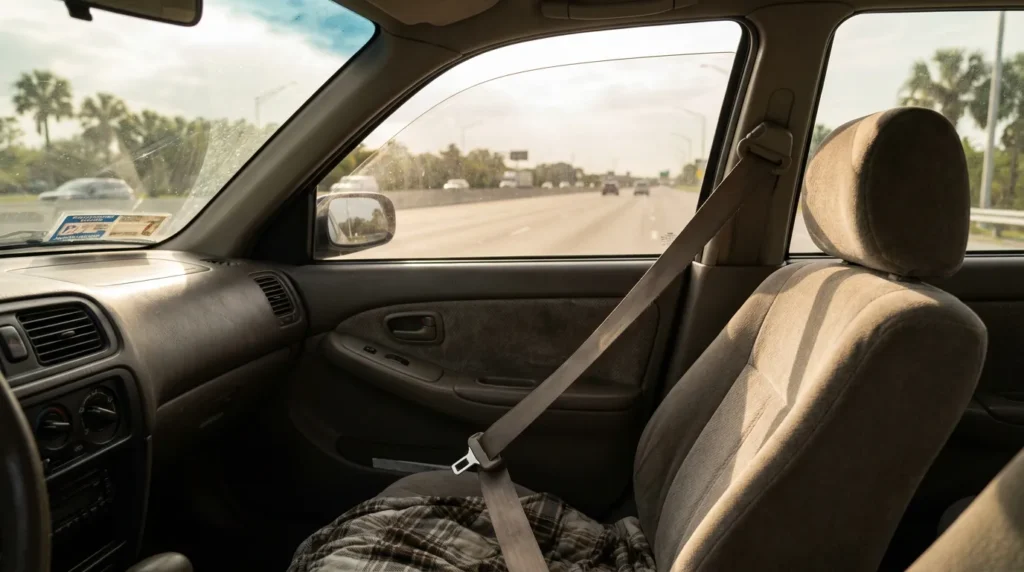
Why Insurance Companies Bring Up Your Seat Belt After a Crash
Key Takeaways: Florida’s seat belt defense argues that an injured person’s failure to wear an available seat belt worsened their injuries. It operates through comparative fault under Fla. Stat. § 768.81, together with Fla. Stat. § 316.614(10) and Insurance Co. of North America v. Pasakarnis. Rather than eliminating your case, it generally reduces damages by the fault percentage a jury assigns. The 2023 tort reform amendment raised stakes by barring recovery entirely for anyone found more than 50 percent at fault in most negligence actions, making your claim’s filing date critical. The defense isn’t automatic: defendants must affirmatively plead and prove both nonuse and that it substantially contributed to injuries, often requiring medical records, injury patterns, or biomechanical testimony. Important carve-outs exist, including Fla. Stat. § 316.613(3), which bars child restraint nonuse from being treated as comparative negligence or admitted as evidence.
If you were hurt in a Central Florida collision and the adjuster keeps asking whether you were buckled, you’re seeing the seat belt defense in action. Florida’s seat belt defense argues that an injured person’s failure to wear an available seat belt contributed to injury severity. It doesn’t accuse you of causing the crash, it asks a jury to assign you a percentage of fault for your harm, reducing your potential recovery.
If an insurer has raised seat belt nonuse in your Orlando car accident case, the team at Norden Leacox can help you understand how Florida’s comparative fault rules apply. Call 407-801-3000 or contact us now to discuss your situation.

How the Seat Belt Defense Florida Car Accident Rule Actually Works
The seat belt defense operates through Florida’s comparative fault statute, Fla. Stat. § 768.81. Fla. Stat. § 316.614(10) provides that a seat belt violation is not negligence per se, but "may be considered as evidence of comparative negligence." The Florida Supreme Court in Insurance Co. of North America v. Pasakarnis, 451 So. 2d 447 (Fla. 1984), held that seat belt nonuse may be considered in mitigation of damages where the defendant proves it. Fault allocated on that basis is handled under Fla. Stat. § 768.81(2) (2024), which provides that contributory fault "diminishes proportionately the amount awarded as economic and noneconomic damages," but "does not bar recovery, subject to subsection (6)." If a jury concludes not wearing a belt worsened your injuries, it may assign you a share of responsibility. Your award is then reduced by that percentage.
This proportional approach exists because Florida abandoned contributory negligence decades ago. In Hoffman v. Jones, 280 So. 2d 431, 436 (Fla. 1973), the Florida Supreme Court replaced contributory negligence with comparative negligence, meaning a plaintiff’s carelessness no longer wipes out a claim entirely. The Florida Bar Journal’s discussion of refining comparative fault in Florida explains that by statute, a defendant pays damages "only in proportion to the percentage of fault by which that defendant contributed to the accident."
The statute covers ordinary car crash litigation. Fla. Stat. § 768.81(1)(c) defines "negligence action" to include, without limitation, civil actions for damages based upon a theory of negligence, strict liability, products liability, professional malpractice, or breach of warranty and like theories. Seat belt-based fault allocation may be available in Orlando crash suits, subject to the defendant meeting its burden.
The 2023 Change That Raised the Stakes
Florida’s tort reform changed comparative fault from pure to modified, significantly impacting seat belt arguments. Under Fla. Stat. § 768.81(6) (2024), a party found more than 50 percent at fault for their own harm "may not recover any damages," with medical negligence claims excepted. While seat belt nonuse alone rarely reaches that threshold, it may combine with other fault findings to push a plaintiff past the bar.
The timing of your claim controls which law applies. Chapter 2023-15 took effect March 24, 2023, and the modified comparative fault provision applies to causes of action filed on or after that date, even if the underlying accident occurred earlier. Claims filed before March 24, 2023 are evaluated under the pure comparative system with no 50 percent cutoff.
Comparative Fault Before and After the Amendment
| Issue | Pure Comparative Fault (Prior Law) | Modified Comparative Fault (Current) |
|---|---|---|
| Effect of plaintiff fault | May reduce damages proportionally | May reduce damages proportionally |
| Recovery at 60% plaintiff fault | Reduced award potentially available | Generally barred under § 768.81(6) |
| Liability structure | Percentage of fault, not joint and several | Percentage of fault, not joint and several |
| Burden on defendant | Plead and prove fault | Plead and prove fault |
💡 Pro Tip: Write down the date of your crash and keep it front and center. Whether the modified comparative fault standard applies depends on when the lawsuit was filed, not merely when the accident occurred.
What a Defendant Must Prove Before the Argument Counts
A seat belt defense is not automatic. Florida’s comparative fault framework, under Fla. Stat. § 768.81(2) (2024) and as interpreted in Insurance Co. of North America v. Pasakarnis, requires a defendant to affirmatively plead and prove the seat belt defense at trial. Under Pasakarnis, that showing includes proof that a functioning belt was available, that failing to use it was unreasonable, and that nonuse substantially contributed to the injuries.
Defendants often need more than a police report notation. They typically rely on medical records, injury patterns, vehicle damage, or biomechanical expert testimony to argue a belt would have reduced harm. Whether that showing succeeds depends heavily on the facts presented.
Common Evidence Issues That Arise
- Crash reports recording belt use inconsistently or based on assumption
- Injury patterns that may or may not correlate with restraint use
- Whether the vehicle’s restraint system functioned properly
- Whether a functioning belt was available at all
Where Damages Land After a Fault Percentage Is Assigned
Florida apportions damages by percentage rather than joint and several liability. Under Fla. Stat. § 768.81(3) (2024), the court "shall enter judgment against each party liable on the basis of such party’s percentage of fault." A jury’s seat belt-related percentage maps directly onto the final judgment. A 15 percent fault finding could reduce a $200,000 verdict to $170,000.
Understanding this math helps injured people evaluate settlement offers realistically. Insurers frequently apply aggressive fault percentages during negotiations, long before a jury weighs in. Learning how comparative negligence impacts settlements helps you recognize when an adjuster’s discount lacks evidentiary support.
Defective Belts and Enhanced Injury Claims
Sometimes the restraint itself is defective. Fla. Stat. § 768.81(3)(b) directs the trier of fact, in cases alleging injuries were enhanced by a defective product, to consider the fault of all persons who contributed to the accident. If a belt, buckle, or retractor failed during a crash, the analysis may extend beyond the other driver.
These claims require preserving the vehicle. Once a car is repaired, salvaged, or crushed, physical proof may disappear permanently. Prompt inspection can make the difference between a viable enhanced-injury theory and one that cannot be developed.
💡 Pro Tip: Do not authorize salvage or repair of a seriously damaged vehicle until someone has evaluated whether the restraint system needs inspection.
Children and Statutory Carve-Outs
Florida treats child restraints differently from adult seat belts. Fla. Stat. § 316.613(3) provides that "the failure to provide and use a child passenger restraint shall not be considered comparative negligence, nor shall such failure be admissible as evidence in the trial of any civil action with regard to negligence." For Orlando crash claims involving injured children, this may meaningfully limit what a defendant may present to a jury.
Why These Carve-Outs Matter to Your Claim
Statutory exceptions may substantially narrow what an insurer can argue. Courts interpret such provisions according to their text, and their application depends on specific facts, the occupant involved, and vehicle type. Outcomes vary based on these fact-sensitive distinctions.
Practical Steps If Seat Belt Nonuse Is Raised in Your Case
Responding effectively often starts with documentation. Injury patterns, emergency records, and vehicle photographs may be more persuasive than recollection alone. An experienced orlando car accident attorney can evaluate whether the insurer’s fault theory has evidentiary support.
Preserve evidence early. Request the crash report, photograph your vehicle before repairs, keep all medical records, and avoid recorded statements about belt use before understanding legal implications. The Florida motor vehicle statutes limit crash report use as evidence, making independent documentation important. These steps cost nothing and may materially affect defenses raised months later.
Frequently Asked Questions
1. Does not wearing a seat belt automatically ruin my Florida claim?
Generally, no. Under Fla. Stat. § 316.614(10), seat belt nonuse is not negligence per se and may only be considered as comparative negligence. Fla. Stat. § 768.81(2) provides that contributory fault reduces damages proportionally rather than barring recovery, subject to subsection (6).
2. Can I be barred from recovering anything?
Yes, in certain circumstances. Fla. Stat. § 768.81(6) (2024) provides that a party found more than 50 percent at fault may not recover damages, except in medical negligence claims. This applies to causes of action filed on or after March 24, 2023.
3. Does the seat belt defense apply to my injured child?
Fla. Stat. § 316.613(3) states that failure to provide and use a child passenger restraint is not comparative negligence and is not admissible as evidence of negligence. Application depends on specific facts, including the child’s age and required restraint.
4. Who has to prove I was not wearing a belt?
The defendant does. Under Fla. Stat. § 768.81(2) and the holding in Pasakarnis, defendants must affirmatively plead and prove the seat belt defense by a preponderance of the evidence. Case law requires proof that nonuse was unreasonable and contributed to the claimed injuries.
5. Does this affect passengers as well as drivers?
It can. The comparative fault framework applies to negligence actions generally as defined under Fla. Stat. § 768.81(1)(c), and § 316.614 addresses front seat passengers and certain occupants, though carve-outs may apply depending on circumstances.
Protecting Your Recovery When Fault Is Contested
Florida’s seat belt defense may be narrower than many insurers suggest. It runs through § 316.614(10) and the comparative fault statute, requires the defendant to plead and prove its case, and often reduces rather than destroys a claim, though the 50 percent threshold added in 2023 raised the stakes. Statutory carve-outs for children may further limit the argument. Every outcome depends on specific facts, evidence preserved, and whether the lawsuit was filed before or after March 24, 2023.
If an adjuster is discounting your car accident claim in Orlando over seat belt nonuse, the attorneys at Norden Leacox are ready to review the evidence with you. Call 407-801-3000 or schedule a consultation to learn more about protecting your seat belt defense compensation.
Disclaimer: This content is for informational purposes only and is not legal advice. Every case is unique, and results may vary. Consult an attorney about your specific circumstances.