


Norden Leacox Accident & Injury Law | September 4, 2026 | Truck Accidents
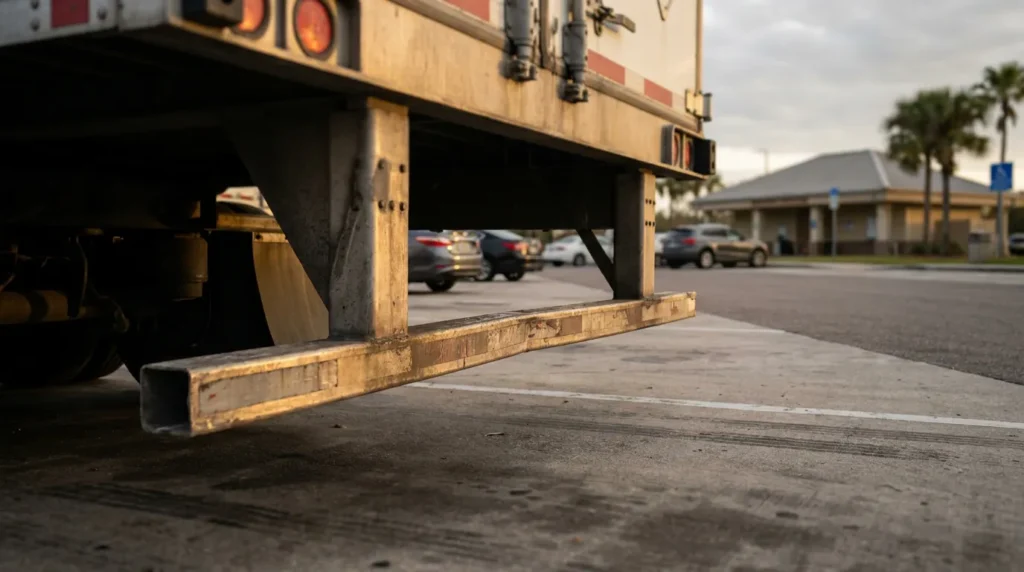
When a Trailer’s Rear Guard Fails to Stop a Car From Sliding Underneath
Key Takeaways: An underride guard failure truck accident occurs when a passenger vehicle slides beneath a tractor-trailer because the steel guard meant to block intrusion bends, breaks, or was inadequate, turning a survivable impact into catastrophic injury. These crashes are common on Orlando corridors like I-4, the 408, and State Road 50, often causing traumatic brain injuries, spinal cord damage, or death. Liability may extend to the driver, motor carrier, trailer owner, guard manufacturer, or maintenance shop. Florida’s modified comparative negligence statute, as amended in 2023, reduces recovery by a claimant’s fault percentage and bars recovery if the claimant is more than 50 percent at fault. Physical evidence can vanish within days, so prompt preservation is critical.
An underride guard failure truck accident happens when a passenger vehicle slides beneath a tractor-trailer because the steel bar designed to block intrusion bends, breaks, or was inadequate. In Orlando, these collisions frequently occur on I-4, the 408, and State Road 50 where trailers slow, turn, or sit disabled. When the guard fails, a survivable rear-end impact becomes catastrophic.
If you or a family member was hurt in an Orlando underride truck crash, Norden Leacox can help evaluate responsibility. Call 407-801-3000 or contact us now to discuss your situation.
Why Underride Collisions Produce Such Devastating Injuries
When a car travels beneath a trailer, the trailer’s frame strikes the windshield and roofline rather than the engine compartment engineered to absorb energy. This produces traumatic brain injuries, spinal cord damage, severe facial trauma, or fatal head injuries. Survivors often face permanent disability and medical costs that dwarf emergency treatment bills.
Rear Underride Versus Side Underride
A rear underride collision typically involves a car striking the back of a stopped or slow-moving trailer. Federal rules require rear impact protection on most trailers, with current performance standards in FMVSS Nos. 223 and 224 applying to trailers manufactured on or after January 26, 1998. The legal question often becomes whether the guard met applicable standards, and whether it was defectively designed, corroded, damaged in a prior impact, or improperly repaired. Compliance with federal minimum standards does not automatically defeat a state-law defect claim. Side underride differs because federal law does not require side guards, shifting focus toward the driver’s turning or crossing maneuver.
Common Failure Points Investigators Look For
A guard that fails rarely does so without leaving evidence. Engineering analysis may reveal weld cracks, rusted mounting brackets, bent vertical supports from earlier crashes, or non-conforming aftermarket parts. Defective guard or bracket claims are pursued under products liability and negligence law.
Who May Be Liable in an Underride Guard Failure Truck Accident
Responsibility often extends beyond the driver. Depending on the facts, the motor carrier, trailer owner, component manufacturer, maintenance company, or cargo loader may share fault. Manufacturers may be held accountable for design and assembly errors that make a guard incapable of withstanding foreseeable impact.
Identifying every potentially responsible party matters in Florida. Under Fla. Stat. § 768.81(3) (2024), judgment is entered against each party "on the basis of such party’s percentage of fault and not on the basis of the doctrine of joint and several liability." If a potentially responsible defendant is left out, that share may go unrecovered.
| Potential Defendant | Typical Theory |
|---|---|
| Truck driver | Negligent stopping, turning, or lighting |
| Motor carrier | Negligent inspection, hiring, or supervision |
| Guard or trailer manufacturer | Defective design or assembly |
| Maintenance or repair shop | Negligent repair of damaged guard |
| Trailer owner or lessor | Failure to maintain equipment |
💡 Pro Tip: Photograph the guard itself, not just the vehicles, and note whether it is bent, missing bolts, or visibly rusted. That single image can become the anchor of a defect claim.
How Florida’s Comparative Fault Statute Shapes These Claims
Florida applies modified comparative negligence, which reduces recovery in proportion to a claimant’s fault. Under Fla. Stat. § 768.81(2) and (6) (2024), contributory fault "diminishes proportionately the amount awarded," and a party found greater than 50 percent at fault may not recover damages. This bar applies to causes of action accruing on or after March 24, 2023. Insurers in underride cases commonly argue that the driver followed too closely or passed unsafely.
Defendants may also shift blame to someone not in the lawsuit. Under Fla. Stat. § 768.81(3)(a)1.-2. (2024), a defendant must affirmatively plead and identify the nonparty and prove that nonparty’s fault before the name appears on the verdict form. Understanding how comparative negligence principles operate helps claimants see why fault allocation drives case value.
The Enhanced Injury Rule for Defective Guards
A defective guard often makes injuries worse rather than causing the crash itself. Fla. Stat. § 768.81(1)(d) and (3)(b) (2024) apply to actions alleging injuries "were greater than the injuries the claimant would have received but for a defective product," and instruct that the trier of fact "shall consider the fault of all persons who contributed to the accident" in apportioning fault for enhanced injuries. This structure allows a single case to combine negligence claims against the carrier with a defect claim against the guard maker.
Evidence That Often Decides an Orlando Truck Accident Guard Failure Case
Physical evidence can disappear quickly, sometimes within days. Trailers get repaired, damaged guards scrapped, and electronic data overwritten. A prompt preservation letter is critical.
Evidence frequently pursued includes:
- The trailer and guard itself, preserved intact for engineering inspection
- Maintenance, inspection, and repair records
- Electronic logging device and event data recorder downloads
- Roadway, business, and dashcam video
- Purchase and part-sourcing records showing who supplied the guard
Our discussion of the evidence Orlando truck crash victims need explains these categories in greater depth.
Damages Available After a Fatal Orlando Semi Truck Underride Claim
When an underride collision is fatal, Florida’s wrongful death statute defines who may recover and for what. The action is brought by the personal representative on behalf of statutory survivors and the estate. Under Fla. Stat. § 768.21(1), each survivor may recover lost support and services from injury to death, with interest, plus future loss reduced to present value.
Non-economic losses are also recognized. Fla. Stat. § 768.21(2)-(3) permits a surviving spouse to recover for loss of companionship and protection and for mental pain and suffering, and permits minor children (under 25), and all children where there is no surviving spouse, to recover for lost parental companionship, instruction, and guidance along with mental pain and suffering. Medical or funeral expenses may also be recovered. The Florida negligence and wrongful death provisions set out these categories in full.
When the Trucker’s Policy Is Not Enough
Catastrophic underride injuries can exceed a carrier’s liability limits, which may bring underinsured motorist coverage into play. Under Fla. Stat. § 627.727(6)(a), written notice of a proposed settlement must be submitted by certified or registered mail to all underinsured motorist insurers, who then have 30 days to respond. Missing that notice step can jeopardize the UIM claim.
Florida law protects the claimant when the UIM insurer refuses permission to settle. Under Fla. Stat. § 627.727(6)(b), a UIM insurer that preserves its subrogation rights must, within 30 days after receiving notice, pay the injured party the amount of the written offer from the underinsured motorist’s liability insurer.
💡 Pro Tip: Locate every auto policy in the household before settling anything. UIM coverage from a resident relative’s policy may apply even if you were not in that vehicle.
Working With an Underride Guard Failure Lawyer in Orlando
Underride cases combine crash reconstruction, federal equipment standards, and product design analysis. These claims frequently require retained engineers, metallurgical testing, and early litigation holds directed at multiple companies. Deadlines matter: for negligence causes of action accruing on or after March 24, 2023, Florida’s general limitations period is two years under Fla. Stat. § 95.11(4), and wrongful death claims carry their own two-year deadline. An underride crash lawyer Orlando families turn to can coordinate that work while physical evidence still exists.
Frequently Asked Questions
1. How is a truck underride accident in Florida different from a normal rear-end crash?
The point of impact separates them. In a standard rear-end collision, crumple zones absorb force, while in an underride the trailer intrudes into the passenger compartment, producing head and neck trauma that ordinary safety systems cannot prevent.
2. Can I still recover if the police report suggests I was partly at fault?
Possibly, subject to Florida’s comparative fault rules. Under Fla. Stat. § 768.81(2), (6) (2024), damages are reduced by your percentage of fault, and for claims accruing on or after March 24, 2023, recovery is barred if you are more than 50 percent at fault. Police reports are not binding on a jury.
3. Who pays when the guard manufacturer and the trucking company are both at fault?
Each generally pays only its own percentage share. Because Fla. Stat. § 768.81(3) (2024) eliminated joint and several liability in most negligence actions, every potentially responsible entity must be identified and named. Leaving one out may reduce what is ultimately collectible.
4. What should I do first after an Orlando trailer underride injury?
Prioritize medical care, then preserve evidence quickly. Ask that the trailer and guard not be repaired or destroyed, gather photographs, and identify witnesses. A written preservation demand to the carrier is often appropriate within days.
5. Does a settlement with the trucking company affect my own insurance claim?
It can, if required notice is not given. Fla. Stat. § 627.727(6)(a) requires certified or registered mail notice to all underinsured motorist insurers before settling in a way that creates a UIM claim. The insurer then has 30 days to respond.
Protecting Your Claim After an Underride Guard Defect in Orlando
An underride guard failure truck accident raises questions a typical car crash claim never touches, from metallurgy and federal equipment standards to Florida’s enhanced injury and apportionment rules. Multiple parties may share responsibility, each paying only its own percentage share, and comparative fault arguments can reduce or bar recovery. Because the trailer, guard, and electronic data can disappear quickly, and filing deadlines are short, timing matters as much as legal theory.
If your family is dealing with the aftermath of an underride collision, Norden Leacox is prepared to investigate what failed and why. Call 407-801-3000 or schedule your consultation to get answers about your options.
Disclaimer: This content is for informational purposes only and is not legal advice. Every case is unique, and results may vary. Consult an attorney about your specific circumstances.