


Norden Leacox Accident & Injury Law | September 9, 2026 | Personal Injury
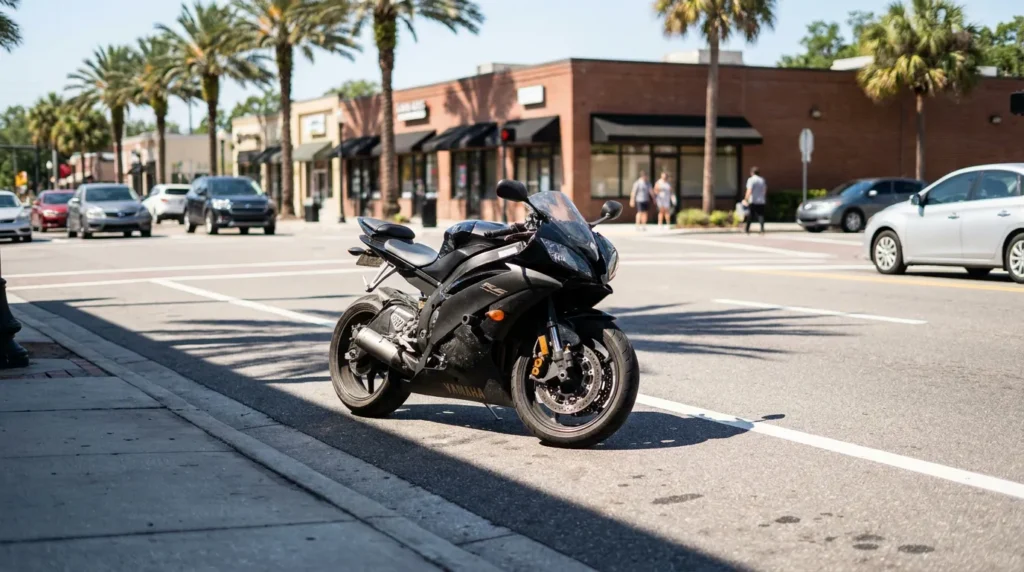
What Every Central Florida Rider Should Understand Before Filtering Through Traffic
Key Takeaways: Florida law bans lane splitting statewide under Fla. Stat. § 316.209(3), applying throughout Orlando, Winter Park, and Kissimmee, with a narrow exemption for on-duty police officers and firefighters. The statute protects riders by addressing full use of a traffic lane, barring passing within an occupied lane, and permitting two motorcycles to ride abreast. Violations are noncriminal traffic infractions, though insurers frequently use them to argue comparative negligence. Because Florida’s mandatory PIP generally excludes motorcycle injuries, optional medical payments and uninsured motorist coverage often become primary recovery sources. Claims require proof of duty, breach, causation, and damages, with most negligence actions accruing after March 24, 2023 subject to a two-year filing deadline.
Riding between stopped or slow-moving cars is illegal in Florida, and that rule shapes far more than a traffic ticket. Under Fla. Stat. § 316.209(3) (2012), "No person shall operate a motorcycle between lanes of traffic or between adjacent lines or rows of vehicles." Yet the statute also includes protections that many Orlando motorists overlook, and understanding both sides of the florida lane splitting motorcycle law can make a meaningful difference if you are hurt on I-4, Colonial Drive, or a congested downtown intersection.
If you were injured in a crash and an insurance company is pointing to the lane-splitting ban to blame you, the team at Norden Leacox can review what happened. Call 407-801-3000 or reach out for a free consultation to discuss your options.
1. The Ban Is Statewide, Not an Orlando Ordinance
Florida’s prohibition on riding between rows of vehicles comes from state law, applying throughout Orlando, Winter Park, Kissimmee, and the entire state. There is no local carve-out for rush hour on I-4, and no traffic-congestion exception appears in the statutory text. Riders sometimes assume that because California permits the maneuver, Florida tolerates it informally, but the statute does not support that assumption.
The relevant provisions live within Florida’s uniform traffic control chapter, which governs vehicle operation on public roadways. Out-of-state riders visiting Central Florida are subject to it regardless of home-state rules.
2. You May Be Entitled to the Full Lane
Florida law addresses a motorcycle’s use of an entire traffic lane, and drivers may not squeeze a rider out of it. Fla. Stat. § 316.209(1) provides that "All motorcycles are entitled to full use of a lane and no motor vehicle shall be driven in such manner as to deprive any motorcycle of the full use of a lane." That is one of the more important rider protections in Florida and frequently a pivot point in liability disputes. This subsection does not apply to motorcycles operated two abreast in a single lane.
When a driver drifts into a rider’s lane space during a merge or lane change, that conduct may constitute a breach of the duty of reasonable care. Florida courts generally treat the violation of a traffic statute as evidence of negligence for the jury to weigh, rather than as conduct that automatically establishes fault.
How Full-Lane Rights Play Out in a Crash Claim
Insurers often argue that a rider "came out of nowhere," when physical evidence may tell a different story. Skid marks, damage patterns, dash camera footage, and witness accounts can establish where each vehicle was in the lane. Preserving that evidence quickly matters, because roadway conditions change and vehicles get repaired or scrapped.
💡 Pro Tip: Photograph the lane markings and the resting position of both vehicles before anything is moved, if you are physically able. Those images can be difficult to reconstruct later.
3. Passing Inside an Occupied Lane Is Separately Prohibited
Even short of full lane splitting, Florida generally bars a rider from overtaking a vehicle within the lane that vehicle occupies. Fla. Stat. § 316.209(2) states that the motorcycle operator "shall not overtake and pass in the same lane occupied by the vehicle being overtaken." This means slipping past a slow car by hugging the lane edge is generally unlawful.
This provision closes a gap riders sometimes try to argue. If you never crossed a lane line but still squeezed by a car within its lane, subsection (2) may still apply. Understanding that distinction is useful when sorting out the lane splitting rules Orlando riders face on crowded arterial roads.
4. Two Abreast Is Legal, Three Is Not
Florida generally permits two motorcycles to share a single lane side by side, but no more. Fla. Stat. § 316.209(4) provides that "Motorcycles shall not be operated more than two abreast in a single lane." Group rides through Central Florida must organize in pairs rather than wider formations.
The full-lane protection in subsection (1) expressly does not apply to motorcycles operated two abreast in a single lane. Riders who pair up may be giving up that statutory claim to the full lane. That nuance can surface in group-ride collisions where positioning becomes contested.
| Maneuver | Status Under Fla. Stat. § 316.209 |
|---|---|
| Riding between lanes or rows of vehicles | Prohibited under subsection (3) |
| Passing within an occupied lane | Prohibited under subsection (2) |
| Two motorcycles abreast in one lane | Permitted under subsection (4) |
| Three or more abreast in one lane | Prohibited under subsection (4) |
| Using the full width of a lane | Protected under subsection (1) |
5. A Violation Is a Traffic Infraction, Not a Crime
Breaking the lane statute generally does not make you a criminal in Florida. Fla. Stat. § 316.209(6) states that "A violation of this section is a noncriminal traffic infraction, punishable as a moving violation as provided in chapter 318." That generally means a fine and potential points against your license rather than arrest, although separate criminal statutes may apply if the underlying conduct is itself a crime, such as reckless driving.
Why an Infraction Still Matters to Your Injury Claim
The greater risk is often how a defense insurer may use it. Under Florida’s modified comparative negligence framework, a rider’s own share of fault generally reduces recovery proportionally, and a rider found more than 50 percent at fault is generally barred from recovering damages. An adjuster may cite illegal lane splitting Florida provisions to argue that the rider bears the majority of responsibility.
That argument is not automatically correct. A traffic citation is not proof of civil liability, causation still must be established, and a driver who changed lanes without looking may remain substantially at fault regardless of where the motorcycle was positioned.
6. On-Duty Officers and Firefighters Are Exempt
Florida carves out a narrow exception for certain first responders. Fla. Stat. § 316.209(5) provides that "Subsections (2) and (3) do not apply to police officers or firefighters in the performance of their official duties." That exemption reaches only the overtaking and lane-splitting provisions during official duties, and generally does not extend to off-duty riding or to civilians.
7. Riders Carry the Same Duties as Drivers, With Key Insurance Gaps
Motorcyclists in Orlando generally hold the same rights and responsibilities as other motorists, subject to motorcycle-specific rules. Fla. Stat. § 316.208(1) grants any person operating a motorcycle or moped "all of the rights" and subjects them to "all of the duties applicable to the driver of any other vehicle under this chapter," except as to special regulations that by their nature cannot apply.
The insurance picture, however, is different. Motorcycles are not subject to Florida’s no-fault PIP requirement, and according to the Florida Bar’s guidance, mandatory personal injury protection "will not cover you if you are injured in a motorcycle accident," although insurers may offer optional medical payments or PIP endorsements for motorcycles.
Riders considering coverage should generally weigh:
- Optional medical payments coverage designed for motorcycle operators
- Uninsured and underinsured motorist coverage, which often becomes the primary source of recovery
- Health insurance coordination provisions that affect reimbursement
- Bodily injury liability limits carried by typical Central Florida drivers
💡 Pro Tip: Request a full declarations page from your insurer, not just a summary card. The declarations page shows whether you actually purchased optional medical coverage.
Building a Negligence Case Under Florida Lane Splitting Motorcycle Law
Motorcycle injury claims in Florida generally rest on four elements: duty, breach, causation, and damages. A claim typically involves showing that the driver owed a duty of reasonable care, breached it, caused the collision, and produced measurable harm. Statutory violations by either party may feed into the breach analysis, but they generally do not replace it.
Medical documentation often carries significant weight, particularly in cases involving traumatic brain injury, spinal damage, or fractures requiring surgical repair. Treating physicians, life care planners, and accident reconstruction professionals may all contribute opinions.
Deadlines That Can End a Claim Before It Starts
Florida’s general negligence limitations period is set by statute, and missing it can permanently bar a claim. Most negligence actions arising from motor vehicle crashes are governed by the statute of limitations for negligence, which currently sets a two-year window for negligence causes of action accruing after March 24, 2023; claims that accrued before that date were subject to a four-year period. Other deadlines may apply to particular claims, and claims against governmental entities involve separate presuit notice requirements.
Tolling and delayed-discovery doctrines exist, but courts generally interpret them narrowly.
Frequently Asked Questions
1. Is lane splitting ever legal in Florida?
Generally, no. Fla. Stat. § 316.209(3) prohibits operating a motorcycle between lanes of traffic, with a narrow exemption under subsection (5) for police officers and firefighters performing official duties.
2. Can I still recover compensation if I was lane splitting when the crash happened?
Possibly. Florida applies modified comparative negligence, so a rider’s percentage of fault reduces recovery and generally bars it entirely if the rider is found more than 50 percent at fault, with the analysis turning on causation and the other driver’s conduct.
3. Does my PIP coverage pay my medical bills after a motorcycle crash?
Typically not. Florida’s mandatory PIP generally does not extend to injuries sustained while operating a motorcycle, which is why optional medical payments and uninsured motorist coverage often become central to a rider’s recovery.
4. What happens if a driver forces me out of my lane?
Fla. Stat. § 316.209(1) prohibits motorists from depriving a motorcycle of full lane use, except where motorcycles are operated two abreast. Evidence of that conduct may support a breach-of-duty argument, though liability depends on the complete factual record.
5. How soon should I talk to an attorney after a motorcycle crash?
As soon as practical. Evidence degrades, witnesses become harder to locate, and statutory deadlines run regardless of how long medical treatment continues.
Protecting Your Rights on Central Florida Roads
Florida’s lane splitting ban is straightforward, but its effect on an injury claim rarely is. The statute that prohibits filtering also addresses riders’ full use of a lane, treats violations as noncriminal infractions, and permits two-abreast riding. Understanding those provisions may help injured riders push back when an insurer tries to convert a traffic infraction into a total defense.
If you or a loved one suffered serious injuries in a crash, an Orlando motorcycle accident attorney at Norden Leacox can evaluate liability, damages, and available coverage. Call 407-801-3000 or schedule your free case review today.
Disclaimer: This content is for informational purposes only and is not legal advice. Every case is unique, and results may vary. Consult an attorney about your specific circumstances.