


zleacox@nordenleacox.com | November 26, 2026 | Truck Accidents
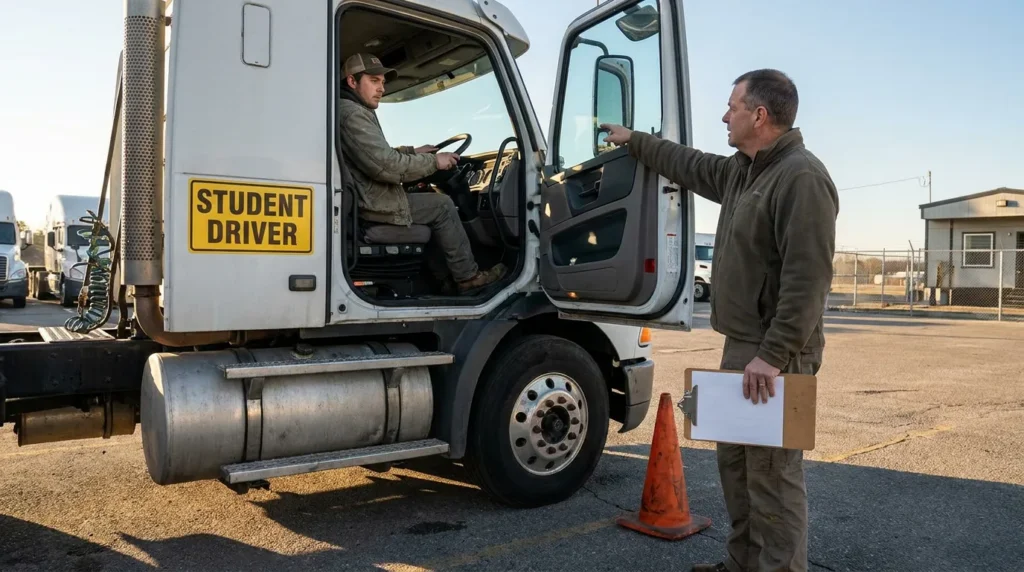
How Driver Training Can Become Key Evidence in Your Truck Accident Case
Key Takeaways: Entry-level driver training (ELDT) is a federal FMCSA requirement under 49 C.F.R. Part 380. Since February 7, 2022, most first-time Class A or Class B CDL applicants, drivers upgrading from Class B to Class A, and drivers seeking a first hazardous materials, passenger, or school bus endorsement must finish theory and behind-the-wheel training with a registered provider before testing. After a crash, missing or noncompliant training may support negligent hiring, training, supervision, or entrustment claims against the trucking company. A training gap does not prove fault on its own. It carries the most weight when the driver’s mistake involves a skill the training should have taught. Comparative fault under Fla. Stat. § 768.81 can reduce or bar recovery, and most negligence claims must be filed within two years, so act quickly.
Entry-level driver training (ELDT) is a federal program that most new commercial drivers must finish before they can get their first commercial driver’s license (CDL). It covers classroom lessons and hands-on practice. After a crash, this training matters because a driver who skipped it, or got it from a noncompliant provider, may not have been properly qualified. If you were hurt in a Lakeland crash with a tractor-trailer or delivery truck, the driver’s training records may help show who was at fault.
Norden Leacox helps truck crash victims in Florida look into driver qualifications, carrier practices, and other evidence that trucking companies may not share on their own. You can call 407-801-3000 or contact us now to talk about your options.

Understanding FMCSA Entry Level Driver Training Requirements
FMCSA entry level driver training is a federal requirement under the ELDT rule at 49 C.F.R. Part 380. It generally applies to people applying for a first Class A or Class B CDL, those upgrading from Class B to Class A, and drivers seeking a first hazardous materials (H), passenger (P), or school bus (S) endorsement. There are exceptions, including for some military drivers and applicants who held a learner’s permit before February 7, 2022 and got their CDL before it expired. The goal is to ensure new drivers meet a basic safety level before operating vehicles that can weigh up to 80,000 pounds.
The Two Parts of ELDT
According to an ELDT program overview, the training has two parts: theory instruction and behind-the-wheel training. Theory instruction usually takes place in a classroom or online and covers vehicle systems, hazard awareness, and safe driving practices. Behind-the-wheel training applies that knowledge on a range and on public roads. The federal rule does not set a minimum number of behind-the-wheel hours. Instead, the instructor must find that the student is proficient.
The ELDT rule took effect on February 7, 2022. Since then, covered drivers generally must finish training with a provider listed on the FMCSA Training Provider Registry (TPR) before taking the CDL skills test, or the knowledge test for a hazardous materials endorsement. The provider must send proof of completion to the registry, creating a record that a careful investigation can sometimes find gaps in.
Why ELDT Is Federal, Not a Florida Statute
Florida has adopted many federal trucking safety rules, but ELDT is still mainly a federal requirement. Under Fla. Stat. § 316.302(1)(a)-(b), owners and drivers of commercial vehicles in interstate commerce generally must follow 49 C.F.R. parts 382-386 and 390-397. Intrastate trucks follow those same parts as they stood on a date set in the statute, subject to exceptions. Part 383, which sets CDL standards, is on the adopted list. Part 380 is not. Even so, Part 383 requires ELDT before certain tests, so Florida enforces ELDT when it issues CDLs.
Florida CDL Rules That Connect to Driver Training
Florida law sets its own licensing requirements, and these often come up next to federal training rules in a truck crash claim. Under Fla. Stat. § 322.01, a "commercial driver license" means a Class A, B, or C license issued under Chapter 322. Under Fla. Stat. § 322.53, anyone who drives a commercial motor vehicle in Florida generally must hold a valid CDL. Limited exceptions exist, but most do not cover drivers who carry passengers or property for hire.
These overlapping rules give an injured person several ways to look into the driver’s background. A lawyer may check whether the driver had the right license class and endorsements, whether training records match the license date, and whether the carrier confirmed any of it.
| Requirement | Source | Why It May Matter After a Crash |
|---|---|---|
| ELDT completion before first CDL skills test | 49 C.F.R. Part 380 (federal) | Missing training may support a claim that the driver was not qualified |
| Valid CDL for commercial driving | Fla. Stat. § 322.53 | An unlicensed or wrongly licensed driver may suggest negligence by the carrier |
| Federal safety rules adopted by Florida | Fla. Stat. § 316.302(1) | May set the standard used to judge the driver’s and carrier’s conduct |
| Penalties for carriers that allow handheld phone use | Fla. Stat. § 316.3025(6)(b) | Shows Florida law can hold carriers responsible for how their drivers behave |
Why Driver Training Matters in a Truck Crash Claim
Poor or missing training can support a negligence claim, but training alone generally does not prove fault. In a Florida negligence case, the injured person usually must prove duty, breach, causation, and damages. ELDT records may help show the trucking company did not take reasonable care, but you would still generally need to connect that failure to the crash. Also, if the carrier admits the driver was acting within the scope of employment, a court may limit or reject separate negligent hiring or training claims, depending on the facts.
Linking Training to Fault
Training gaps may be most persuasive when the driver’s mistake matches a skill the training should teach. Say a new driver jackknifed while braking on a wet stretch of I-4. Missing instruction on skid control and space management could matter there. If the crash had nothing to do with those skills, a training gap may carry less weight.
Training issues can also point to more than one responsible party. Depending on the evidence, a claim might involve:
- The driver, for unsafe operation of the truck
- The motor carrier, for negligent hiring, training, supervision, or entrustment
- A training provider, in limited cases where its conduct contributed to the harm
- A cargo loader or vehicle manufacturer, if improper loading or defective parts played a role
Carrier Accountability Under Florida Law
Florida law can hold trucking companies responsible for how their drivers behave. Under Fla. Stat. § 316.3025(6), a truck driver who texts or uses a handheld phone while driving may face civil penalties, plus CDL disqualification for repeat violations. A carrier that requires or allows this can face higher penalties.
Regulatory penalties are separate from your injury claim. A fine paid to the state does not pay your medical bills or lost wages. Still, regulator findings may be useful evidence, depending on the rules of evidence. Under Fla. Stat. § 316.3026, carriers under an out-of-service order may not operate on Florida roads, and some violations are third-degree felonies.
💡 Pro Tip: Ask your attorney whether the carrier had any compliance reviews or out-of-service orders before your crash. A history of violations may help show a pattern of unsafe practices.
Evidence to Preserve When Training May Be an Issue
Training records can disappear over time, so act quickly to preserve evidence. Federal rules require carriers to keep driver qualification files only while the person works there plus three years, and some other records have shorter retention periods. To learn how these records fit together, see our guide on driver qualification files. Other key evidence may include ELD and logbook data, ECM or EDR downloads, maintenance records, dashcam video, and witness statements.
An early preservation letter may help protect this evidence before routine deletion erases it. Trucking companies and their insurers often start investigating within hours of a serious crash, while some evidence, such as video, may be recorded over within days or weeks.
💡 Pro Tip: Keep a simple notebook or phone note listing every doctor visit, missed workday, and out-of-pocket cost. These records support the damages part of your claim.
How Comparative Fault and Deadlines Affect Your Recovery
Florida’s comparative fault law can reduce or bar recovery, so the evidence about fault matters a great deal. Under Florida’s comparative fault statute, Fla. Stat. § 768.81, a plaintiff’s damages are generally reduced by their own percentage of fault. For negligence actions filed after March 24, 2023, a plaintiff found more than 50% at fault generally cannot recover at all. Medical negligence claims are an exception. Insurers may try to shift blame onto the injured person, and evidence of poor driver training may help push back.
Florida also sets strict filing deadlines. Under Fla. Stat. § 95.11, most negligence claims that arose after March 24, 2023 generally must be filed within two years. Claims that arose earlier generally have a four-year deadline. Wrongful death claims have their own two-year deadline. Claims involving government-owned vehicles may have separate notice rules under Fla. Stat. § 768.28. Because a missed deadline could end a claim, check your timeline early.
Frequently Asked Questions
1. Does every truck driver have to complete ELDT?
No. The rule generally applies to drivers getting their first Class A or Class B CDL, upgrading from Class B to Class A, or getting a first hazardous materials, passenger, or school bus endorsement on or after February 7, 2022. Drivers licensed before that date usually did not have to complete it.
2. Can I sue a trucking company for poor driver training?
In many cases, a carrier may be liable for negligent hiring, training, or supervision, and also for its employee’s negligent driving. You would generally need to show that the training failure contributed to the crash and your injuries.
3. How can I find out whether the driver completed FMCSA entry level driver training?
An attorney may request training certificates, Training Provider Registry information, and the driver qualification file during an investigation or discovery. Carriers do not usually share these records on their own.
4. Will a training violation automatically win my case?
No. A violation may be strong evidence, but you would generally still need to prove causation and damages. Comparative fault under Fla. Stat. § 768.81 may also affect how much you can recover.
5. What compensation might be available after a truck crash?
Depending on the facts, damages may include medical expenses, lost income, reduced earning capacity, and pain and suffering. Catastrophic injuries may also involve future care costs.
Protecting Your Rights After a Lakeland Truck Crash
FMCSA entry level driver training sets a basic skill level that covered new commercial drivers must meet before they drive. When a driver or carrier ignores that standard, the records left behind may help show negligence in a Lakeland truck crash claim. Speaking with an FMCSA entry level driver training lawyer may help you understand how these rules apply to your case.
If a commercial truck crash has changed your life, the team at Norden Leacox truck injury attorneys can help you investigate what happened and look into every party who may be responsible. Call 407-801-3000 today or schedule a free consultation to start protecting your claim.
Disclaimer: This content is for informational purposes only and is not legal advice. Every case is unique, and results may vary. Consult an attorney about your specific circumstances.