

[email protected] | June 28, 2026 | Car Accidents
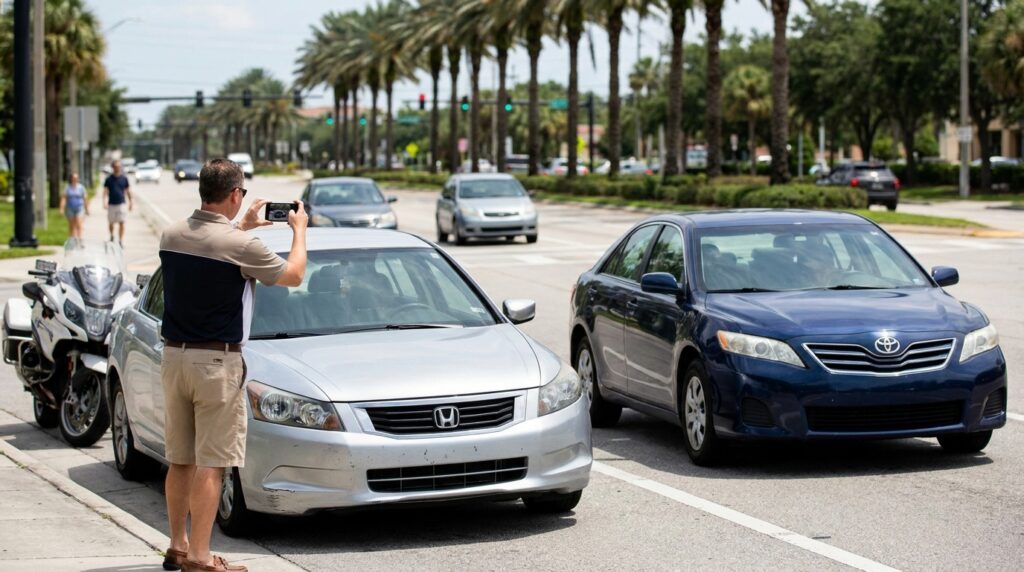
Understanding Fault After an Orlando Crash
Key Takeaways: To prove another driver was at fault in Orlando, you must establish the four elements of negligence, duty, breach, causation, and damages, by a preponderance of the evidence, often anchored by Florida’s careless driving standard under F.S. § 316.1925. Strong proof combines the official crash report, scene photographs, witness statements, traffic camera footage, and medical records. Because Florida applies modified comparative fault, victims found more than 50 percent at fault are barred from recovery. Camera footage can create a rebuttable presumption of a failure to stop at a traffic signal in enforcement proceedings under the Mark Wandall Traffic Safety Program. Acting quickly preserves critical evidence and protects your case against the two-year statute of limitations for claims accruing on or after March 24, 2023. An experienced attorney can secure footage before it is overwritten and counter insurer attempts to inflate your share of fault.
Proving that another driver caused your Orlando wreck comes down to evidence, statutory standards, and a clear showing of negligence. To recover compensation, you must establish that the other driver owed you a duty of care, breached that duty, and caused your injuries and damages. Because Florida uses a fault-based liability system, the strength of your documentation determines whether you are fairly compensated.
If you are recovering from injuries and unsure how to protect your claim, the team at Norden Leacox is ready to help. Call our office at 407-801-3000 for a confidential review or reach us through our online case evaluation form.
What "Fault" Legally Means in Florida
Fault in a car accident case is a question of negligence. Florida law defines negligence as a civil claim for damages where the substance of the action determines whether it qualifies as a negligence action.
To win, you must prove the four classic elements by a preponderance of the evidence. This means showing it is more likely than not that the other driver was negligent. The elements include duty, breach, causation, and damages. A common statutory anchor for "breach" is careless driving, though a statutory violation is evidence of negligence rather than automatic proof of liability.
The Careless Driving Standard
Florida sets a baseline duty for every motorist through its careless driving statute.
Under F.S. § 316.1925(1), any person operating a vehicle upon the streets or highways within the state shall drive the same in a careful and prudent manner so as not to endanger the life, limb, or property of any person.
Evidence that the other motorist violated this standard, such as speeding, tailgating, or distracted driving, can form a foundational element in proving liability. Review the full text within Florida’s motor vehicle traffic statutes for additional context.
💡 Pro Tip: Write down your own recollection of how the crash happened as soon as possible. Memory fades quickly, and a contemporaneous note can later support your account when an insurer challenges your version of events.
Gathering the Evidence That Proves Liability
Strong Orlando car accident evidence usually begins at the scene and continues through your medical treatment. The proof that determines fault is rarely one single item. Instead, it is the combination of official records, physical evidence, and witness accounts that paints a clear picture.
Consider preserving the following categories of proof:
- The official crash report and any citations issued
- Photographs of vehicle damage, road conditions, and visible injuries
- Names and statements from independent witnesses
- Traffic camera or surveillance footage near the intersection
- Your medical records linking injuries to the collision
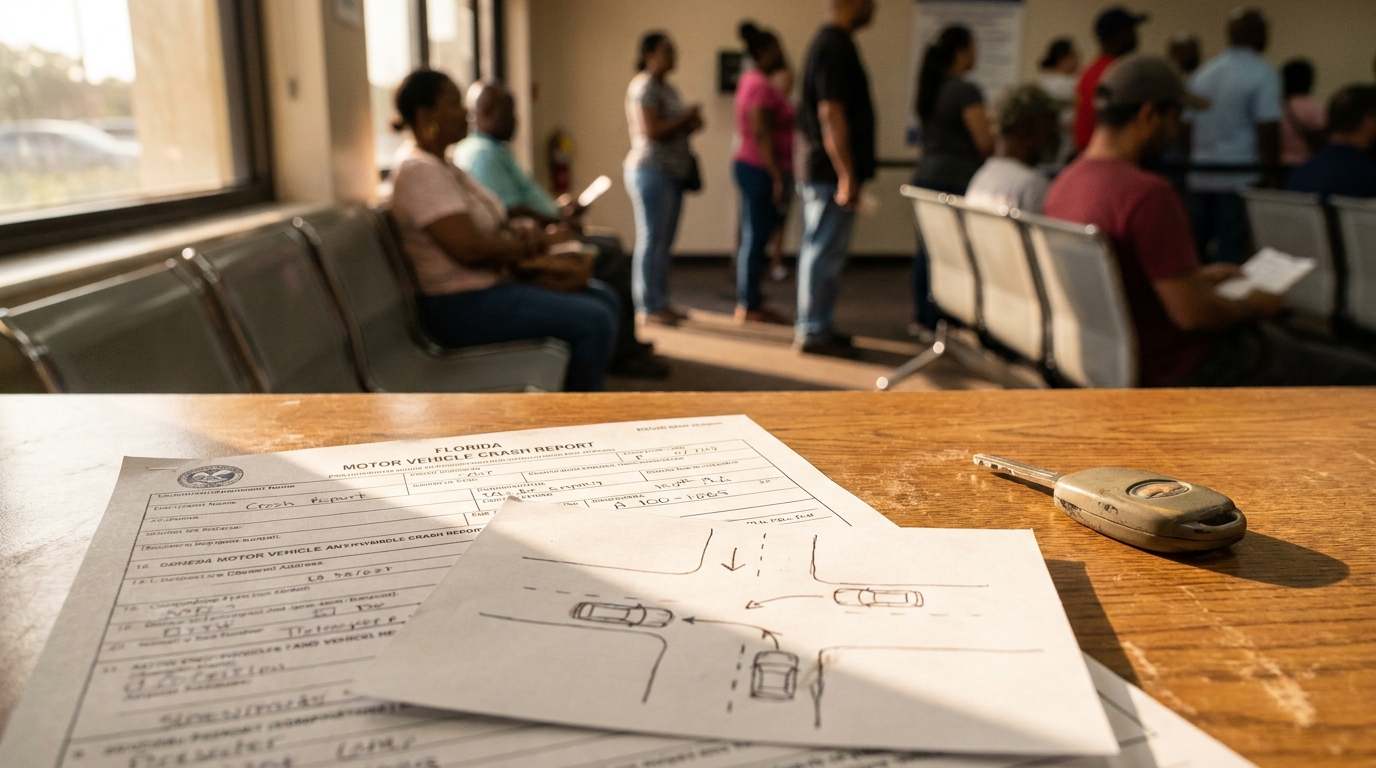
The Florida Traffic Crash Report is often the cornerstone of a fault determination.
Under F.S. § 316.066, a Florida Traffic Crash Report, Long Form must be completed within 10 days after an officer investigates a crash that resulted in death, personal injury, or complaints of pain or discomfort.
This report includes the date, time, location, vehicle descriptions, parties, witnesses, officer observations, and insurance details. While generally inadmissible as evidence at trial under Florida’s accident report privilege, the underlying information it captures is invaluable for investigation.
💡 Pro Tip: Request a copy of the long-form crash report rather than the short form. The long form contains the narrative and diagram that help reconstruct how the collision occurred.
Camera Evidence and Red-Light Violations
When a driver runs a red light in Orlando, traffic camera evidence can carry significant legal weight.
Under F.S. § 316.0083(1)(e), photographic or electronic images and streaming video attached to or referenced in a traffic citation are admissible in proceedings to enforce this section and raise a rebuttable presumption that the motor vehicle shown was used in violation of s. 316.074(1) or s. 316.075(1)(c)1 (failure to stop at a traffic signal).
This footage can be a powerful tool in establishing that the other driver caused the crash.
Documenting Your Injuries and Losses
Proving fault is only half the equation; you also need to prove your damages. Medical records, diagnostic imaging, and treatment notes connect your injuries directly to the collision. Without this link, an insurer may argue your harm came from a pre-existing condition. For a deeper look at the records that matter, our guide on the evidence that strengthens an injury claim walks through practical documentation strategies.
How Comparative Fault Affects Your Recovery
Florida follows a modified comparative fault system that can reduce or even eliminate your recovery.
Under F.S. § 768.81(6), any party found to be greater than 50 percent at fault for his or her own harm may not recover any damages, except in medical negligence actions.
Crossing that threshold permanently bars compensation, so building a record that places primary responsibility on the other driver is essential.
Partial fault, however, does not end your case.
Under F.S. § 768.81(2), contributory fault chargeable to the claimant diminishes proportionately the amount awarded as economic and noneconomic damages, but does not bar recovery, subject to the more-than-50-percent rule.
A victim found partially responsible can still recover a reduced award. Review the apportionment framework in Florida’s negligence and damages chapter for the governing language.
| Your Share of Fault | General Effect on Recovery |
|---|---|
| 0% to 50% | Damages reduced by your percentage |
| More than 50% | Recovery generally barred |
Florida also applies several liability rather than joint liability in most negligence actions.
Under F.S. § 768.81(3), the court shall enter judgment against each party liable on the basis of that party’s percentage of fault and not on the basis of joint and several liability.
Defendants may also try to shift blame to someone not part of the lawsuit by proving at trial the nonparty’s fault.
💡 Pro Tip: Avoid apologizing or speculating about fault at the scene or to an adjuster. Even a casual statement can later be characterized as an admission and used to increase your comparative share.
Why You May Need an At Fault Car Accident Lawyer Orlando Victims Rely On
Proving negligence under Florida’s statutes often requires more resources than an injured person can manage alone. An experienced legal team can locate camera footage before it is overwritten, retain accident reconstruction professionals, and counter insurer attempts to inflate your percentage of fault.
Drivers also have legal duties at the scene that can support your claim.
Under F.S. § 316.062(1), the driver of any vehicle involved in a crash resulting in injury, death, or property damage must give his or her name, address, and vehicle registration number to injured persons, other drivers, and law enforcement.
A driver’s failure to meet this duty is itself a violation and can help establish involvement and potential liability.
Deadlines are equally critical to protecting your rights. Florida’s statute of limitations for most negligence claims is two years for causes of action accruing on or after March 24, 2023.
Under F.S. § 95.11, an action founded on negligence must be filed within two years, and an action for wrongful death likewise carries a two-year limit.
Courts interpret exceptions narrowly. To protect your timeline, consult the firm’s dedicated Orlando car accident attorney page for guidance.
💡 Pro Tip: Confirm your filing deadline early. Because the negligence limitation period was shortened in recent years, assumptions based on older rules can lead to a missed deadline and a lost claim.
Frequently Asked Questions
1. How long do I have to file an Orlando car accident lawsuit?
Most negligence-based claims must be filed within two years of the crash.
F.S. § 95.11 sets a two-year limit for actions founded on negligence accruing on or after March 24, 2023.
Missing this deadline can permanently bar your right to compensation.
2. What if I was partly responsible for the crash?
Partial fault reduces but does not eliminate your recovery.
Under F.S. § 768.81(2), contributory fault proportionately diminishes your award but does not bar recovery, subject to the 50 percent rule.
If you are found more than 50 percent at fault, recovery is generally barred.
3. Is a police crash report enough to prove fault?
A crash report is valuable, but it is rarely sufficient by itself. It documents key facts and officer observations, yet the report itself is generally privileged from admission at trial. Camera footage, witness accounts, and medical records strengthen the proof considerably.
4. Can traffic camera footage really prove the other driver ran a red light?
Yes, and it can carry a statutory presumption in certain enforcement proceedings.
F.S. § 316.0083(1)(e) makes such images and video admissible when attached to or referenced in a traffic citation in proceedings to enforce the section, and creates a rebuttable presumption that the vehicle shown violated s. 316.074(1) or s. 316.075(1)(c)1. The opposing party may still present contrary evidence.
5. What happens if the at-fault driver left the scene?
A driver who leaves may have violated Florida’s scene duties.
F.S. § 316.062(1) requires drivers to provide identifying and registration information after a crash involving injury or property damage.
Failure to comply is a violation that may support liability and additional avenues of recovery.
Protecting Your Right to Fair Compensation
Proving the other driver was at fault in Orlando depends on prompt evidence preservation, accurate application of Florida’s negligence statutes, and a careful response to comparative fault arguments. From the careless driving standard to camera footage and the two-year filing deadline, each piece shapes your ability to recover. Early action and thorough documentation matter.
If another driver’s negligence upended your life, the attorneys at Norden Leacox are prepared to investigate, document, and advocate for your recovery. Call us today at 407-801-3000 or submit your details through our confidential contact page to learn how we can help protect your claim.
