

Norden Leacox Accident & Injury Law | April 8, 2026 | Car Accidents
What Evidence Strengthens an Orlando Car Accident Injury Claim?
The strength of your Orlando car accident injury claim depends on the quality and timing of evidence you collect. Acting quickly to gather and preserve evidence establishes the sequence of events, demonstrates fault, and documents the full extent of your damages. Whether you were a driver, passenger, pedestrian, or cyclist, the proof you secure after a crash can determine your path to fair compensation. Florida’s no-fault insurance framework and modified comparative negligence rules make organized documentation critical.
If you were recently injured in an Orlando car accident and need guidance on protecting your claim, Norden Leacox can help. Call 407-801-3000 or reach out online to discuss your situation.
Why Prompt Evidence Collection Matters After an Orlando Car Wreck
Evidence gathered at the scene and in the days following a crash becomes the foundation for every stage of your claim. Physical conditions change rapidly after a collision. Skid marks fade, debris gets cleared, and traffic camera footage may be overwritten. The sooner you begin documenting, the more complete your evidentiary record will be.
Florida’s legal landscape makes early action especially important. Under Florida Statute 627.736, injured parties must seek initial medical treatment within 14 days of the accident to qualify for Personal Injury Protection (PIP) benefits. Missing that window can eliminate significant coverage and weaken your documented injury timeline.
💡 Pro Tip: Set a reminder on your phone for key deadlines after your accident. The 14-day PIP treatment window is one of the most commonly missed deadlines in Florida car accident claims.

Scene Evidence: Photographs, Videos, and Physical Documentation
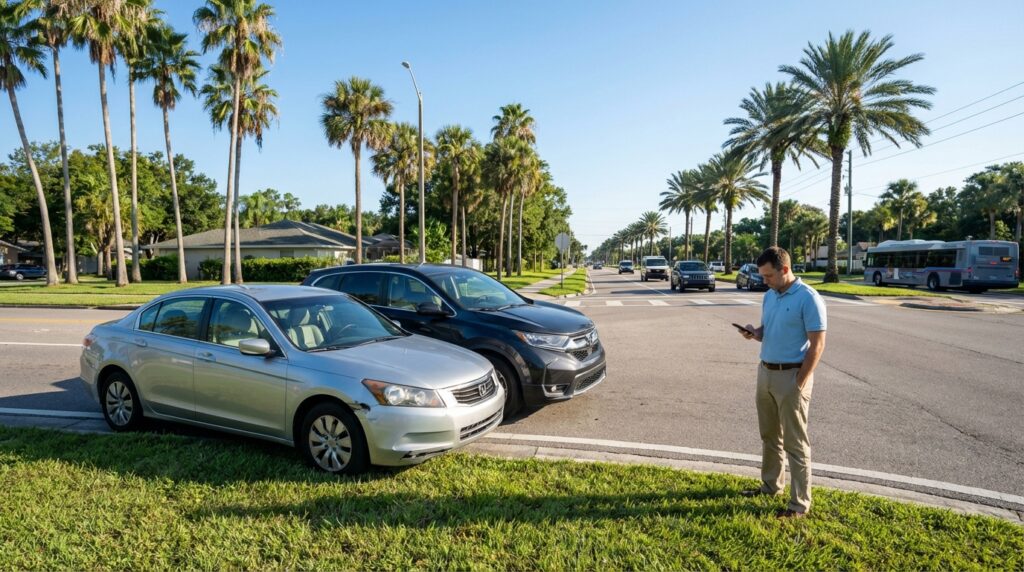
Photographs taken at the crash scene are among the most persuasive forms of proof. Images of vehicle positions, damage, debris patterns, skid marks, traffic signs, signals, and weather conditions all support the narrative of how the collision occurred. If physically able, use your phone to capture wide-angle shots and close-ups from multiple angles.
What to Photograph at the Scene
- Vehicle damage and final resting positions
- Skid marks, road debris, and pavement gouges
- Traffic control devices
- Weather conditions and visibility
- Any visible injuries
Beyond photos, collect contact information from anyone who witnessed the collision. Statements from uninvolved bystanders carry particular weight because they have no personal stake in the outcome. If a witness is willing to share their account, record it on your phone or write down key details while fresh.
Medical Records: The Link Between the Crash and Your Injuries
Thorough medical documentation is one of the most important categories of evidence. Emergency room records, follow-up appointment notes, and diagnostic imaging results verify the severity of your injuries and connect them directly to the accident. Gaps in treatment or delayed care give insurers an opening to argue your injuries were pre-existing or unrelated.
The 14-Day PIP Deadline
Florida’s no-fault system requires every motor vehicle owner to carry at least $10,000 in PIP coverage, which pays benefits regardless of fault. To access those benefits, you must receive initial medical care within 14 days of the collision. If your injuries are classified as an Emergency Medical Condition (EMC), you may be eligible for the full $10,000 in medical benefits. If not, available medical benefits may be capped at $2,500.
💡 Pro Tip: Even if symptoms feel minor, see a medical provider promptly. Some injuries, such as soft tissue damage or concussions, may not present obvious symptoms for several days.
Pain Journals and Daily Impact Records
A personal pain journal can be powerful for proving non-economic damages like pain and suffering. Detailed entries describing your pain levels, emotional distress, sleep disruptions, and daily limitations illustrate how the crash has changed your life. Courts and insurance adjusters often undervalue these losses without concrete, day-to-day documentation.
How a Car Accident Attorney in Orlando Uses Evidence to Build Your Case
An experienced car accident attorney in Orlando understands how to organize raw evidence into a compelling legal narrative. From obtaining official crash reports early to retaining professionals who can reconstruct the accident scene, legal counsel can identify gaps in your evidence and fill them before they become weaknesses. You can learn more about why attorneys start working on your case sooner than many people realize.
Professionals such as accident reconstructionists, medical practitioners, and economic analysts can significantly strengthen complex claims. Reconstructionists analyze physical evidence to recreate the crash and establish fault. Medical professionals explain the long-term prognosis of your injuries in terms a jury can understand. Economic analysts project future lost earnings and the cost of ongoing care, which may substantially increase your claim value.
💡 Pro Tip: Keep every receipt, bill, and written correspondence related to your accident in one organized folder. This includes towing invoices, rental car costs, pharmacy receipts, and rideshare expenses for medical appointments.
Florida’s Comparative Negligence Rules and Why Fault Evidence Is Critical
Florida follows a modified comparative negligence system, which means your recovery may be reduced by your own percentage of fault, and you are barred from recovering any damages if you are found to be more than 50 percent at fault. Effective March 24, 2023, Florida’s tort reform legislation (HB 837) shifted the state from pure comparative negligence to modified comparative negligence. Under current law, a plaintiff who is 50 percent or less at fault may recover damages reduced in proportion to their share of responsibility, but a plaintiff found greater than 50 percent at fault is completely barred from recovery.
This rule makes it essential to gather strong evidence clearly establishing the other party’s degree of responsibility. Under the Fabre v. Marin ruling, fault can even be apportioned among non-party defendants, which means insurance companies may attempt to shift blame to parties not involved in your lawsuit. Detailed scene evidence, witness statements, and reconstruction analysis help counter these tactics.
| Evidence Type | What It Proves | Why It Matters in Florida |
|---|---|---|
| Scene photographs and video | How the crash occurred, road conditions, vehicle positions | Supports fault determination under modified comparative negligence |
| Medical records and bills | Injury severity, treatment necessity, connection to crash | Required for PIP benefits and pain-and-suffering threshold |
| Witness statements | Independent account of what happened | Counters conflicting narratives from the other party |
| Pain journal | Daily impact of injuries on quality of life | Supports non-economic damage claims under Fla. Stat. 627.737 |
| Financial documentation | Lost wages, out-of-pocket costs, future expenses | Quantifies economic damages for full recovery |
Proving Pain and Suffering Beyond PIP in Orlando
To pursue damages beyond what PIP covers, Florida Statute 627.737 requires proof that your injury caused one or more of the following: a significant and permanent loss of an important bodily function, a permanent injury within a reasonable degree of medical probability, or significant and permanent scarring or disfigurement. This threshold makes strong medical evidence essential. Without clear documentation tying your condition to the crash and demonstrating its lasting impact, you may be limited to PIP benefits alone.
💡 Pro Tip: Ask your treating physician to include detailed notes about functional limitations, prognosis, and whether your condition is likely permanent.
Working With a Car Accident Attorney in Orlando to Protect Your Claim
Every piece of evidence you collect contributes to a clearer picture of what happened and who should be held accountable. From scene photos and medical records to witness accounts and financial documentation, the combined weight of your evidence determines what compensation may be available. Florida’s modified comparative negligence system, PIP requirements, and serious injury threshold all create procedural hurdles that organized evidence can help you overcome.
- Gather scene evidence immediately after the crash when possible
- Seek medical treatment within 14 days to preserve PIP eligibility
- Maintain a pain journal documenting daily effects of your injuries
- Keep all financial records related to accident-related expenses
- Consult an Orlando auto accident lawyer as early as possible
Frequently Asked Questions
1. What is the most important evidence to collect after a car accident in Orlando?
Scene photographs, medical records, and witness statements generally form the core of a strong claim. Capturing vehicle damage, road conditions, and traffic signals establishes how the crash occurred, while prompt medical treatment creates the documented link between the accident and your injuries.
2. How long do I have to see a doctor after a car accident in Florida?
Under Florida Statute 627.736, you must seek initial medical care within 14 days of the accident to qualify for PIP benefits. Missing this deadline may result in complete loss of PIP coverage for your injuries.
3. Can I still recover compensation if I was partially at fault for the accident?
Under Florida’s modified comparative negligence system, you may recover damages if you were 50 percent or less at fault, but your recovery is reduced by your percentage of responsibility. If you are more than 50 percent at fault, you are barred from recovering damages.
4. What does it take to pursue pain and suffering damages in Florida?
Florida Statute 627.737 requires that you demonstrate a significant and permanent loss of an important bodily function, a permanent injury within a reasonable degree of medical probability, or significant and permanent scarring or disfigurement. Meeting this threshold typically depends on detailed medical evidence and consistent treatment records.
5. Why should I keep a pain journal after my car accident?
A pain journal documents the daily impact of your injuries, including pain levels, emotional distress, and limitations on normal activities. This record provides valuable evidence when pursuing non-economic damages that are otherwise difficult to quantify.
Take the Next Step to Protect Your Orlando Car Accident Claim
Building a strong car accident claim in Orlando requires prompt action, organized documentation, and a clear understanding of Florida’s no-fault and modified comparative negligence rules. The evidence you gather today may shape the compensation you recover tomorrow. If you are dealing with injuries, mounting bills, or insurance disputes after a crash, the team at Norden Leacox is ready to review your case. Call 407-801-3000 or contact us today to get started.
